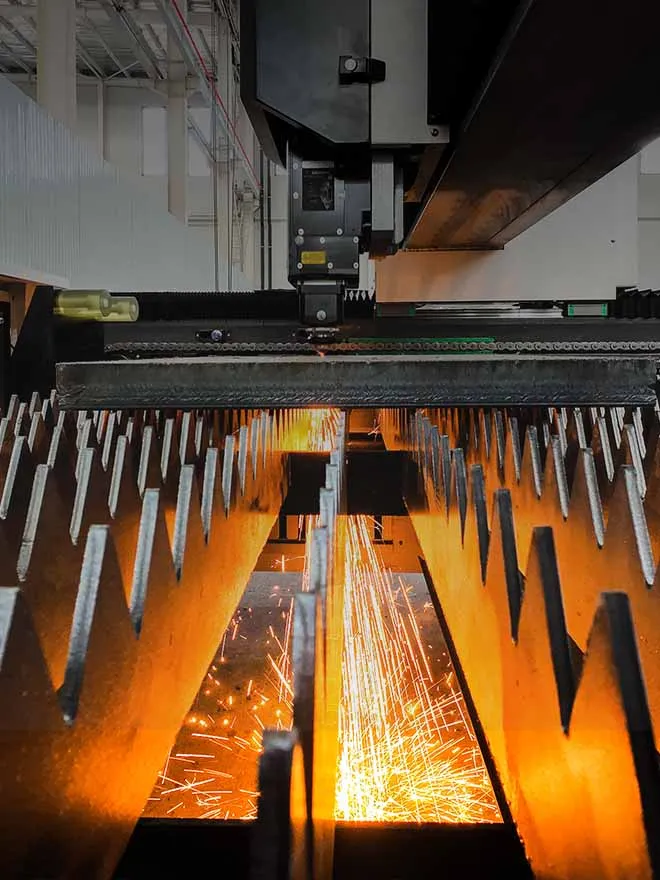
High-speed fiber laser cutting requires more than laser power. As a CNC laser cutting machine accelerates, decelerates, or changes direction, mechanical vibration can affect the stability of the cutting process.
For sheet metal manufacturers, maintaining consistent machine movement is an important consideration, particularly when processing parts with complex contours, sharp corners, or frequent directional changes.
HAISINN demonstrates the role of vibration suppression through a side-by-side cutting comparison, showing the machine operating with the function enabled (ON) and disabled (OFF).
Quick Answer: Vibration suppression helps control unwanted oscillation during machine movement, particularly around acceleration, deceleration, and directional changes. By supporting more stable motion, it can help reduce vibration-related cutting inconsistencies. Its actual effectiveness depends on the machine structure, motion control configuration, cutting parameters, and operating conditions.
Why Does Vibration Occur During High-Speed Laser Cutting?
A fiber laser cutting machine relies on coordinated movement between its cutting head, gantry, transmission system, and motion controller.
During rapid movement, changes in acceleration generate dynamic forces within the machine. These forces may produce mechanical oscillation, especially when the cutting path involves repeated starts, stops, or sharp directional changes.
Several factors can influence cutting stability:
- Rapid acceleration and deceleration.
- Frequent changes in cutting direction.
- Mechanical rigidity and structural response.
- Motion control settings.
- Machine installation and operating conditions.
Not every cutting defect is caused by vibration. However, when mechanical oscillation affects the cutting process, it may contribute to inconsistent edge appearance or reduced contour stability.
For industrial buyers, this makes dynamic performance an important consideration alongside laser power and working area.
What Is Vibration Suppression in a CNC Laser Cutting Machine?
Vibration suppression refers to control measures designed to reduce unwanted mechanical oscillation during machine movement.
In a CNC fiber laser cutting machine, the purpose is to support more stable motion when the equipment accelerates, decelerates, or changes direction.
Depending on the equipment and control configuration, vibration management may involve motion-control optimization and coordination with the machine’s mechanical structure.
The objective is not simply to make the machine move faster. It is to maintain controlled movement throughout the cutting process.
This distinction matters because a machine’s maximum travel speed alone does not establish its ability to maintain consistent cutting performance on complex parts.
HAISINN Demonstration: Vibration Suppression ON vs. OFF
To illustrate the role of vibration suppression, HAISINN presents a side-by-side fiber laser cutting demonstration comparing two operating states.
| Comparison |
Operating State |
| Vibration Suppression ON |
Cutting demonstration with vibration suppression enabled |
| Vibration Suppression OFF |
Cutting demonstration with vibration suppression disabled |
The comparison provides a visual reference for understanding how vibration management relates to the cutting process.
The video is intended to demonstrate the difference between the two operating states. It should not be interpreted as a quantified accuracy, speed, or productivity test without corresponding measurement data.
For buyers evaluating industrial laser cutting equipment, this type of demonstration can serve as a useful starting point for discussing motion stability with the manufacturer.
How Can Vibration Suppression Support Cutting Quality?
The potential value of vibration suppression becomes clearer when examining common sheet metal cutting requirements.
1. More Stable Motion During Directional Changes
Complex cutting paths often require the cutting head to change direction repeatedly.
Controlling unwanted oscillation during these movements can support more consistent machine motion, particularly around corners and short cutting segments.
2. Reduced Influence of Mechanical Oscillation
Mechanical vibration can interfere with the intended movement of the cutting system.
Vibration suppression aims to limit this influence, helping the machine follow its programmed motion more consistently.
3. Greater Attention to Cutting Consistency
For production workshops, cutting consistency is an important part of equipment evaluation.
Although edge quality also depends on material properties, laser power, assist gas, cutting speed, and process settings, mechanical stability remains one of the factors worth examining.
Vibration suppression should therefore be considered as part of the complete cutting system rather than a standalone guarantee of finished-part quality.
Why Do Machine Structure and Motion Control Both Matter?
Vibration suppression should not be evaluated independently of the machine’s mechanical construction.
The machine bed, gantry, transmission system, and motion controller all contribute to overall dynamic behavior.
A rigid mechanical structure provides the physical foundation for stable movement, while appropriate motion control helps manage the machine’s response during operation.
For buyers comparing fiber laser cutting machines, it is useful to examine how these elements work together rather than focusing on a single advertised feature.
This is particularly relevant when purchasing equipment for continuous sheet metal production or processing parts with demanding contour requirements.
HAISINN’s Approach to Cutting Stability
As a manufacturer of laser processing equipment and metal fabrication solutions, HAISINN recognizes the importance of machine stability in industrial cutting applications.
The vibration suppression ON/OFF demonstration provides a practical way to introduce this technical consideration and help customers better understand the relationship between motion control and cutting performance.
For manufacturers planning to invest in a fiber laser cutting machine, evaluating dynamic stability alongside cutting capacity, machine structure, and production requirements can support a more informed purchasing decision.
Conclusion: Stable Motion Matters in High-Speed Laser Cutting
Vibration suppression is an important consideration when evaluating the dynamic performance of a CNC fiber laser cutting machine.
By addressing unwanted oscillation during movement, it can contribute to more stable cutting operation. However, its effectiveness should always be considered together with the machine structure, control system, and actual production requirements.
Looking for a fiber laser cutting solution for your workshop?
Contact HAISINN with your material type, thickness, sheet dimensions, and production requirements. Our team can discuss suitable equipment configurations and available cutting demonstrations.
FAQ
What is vibration suppression in a fiber laser cutting machine?
Vibration suppression is a function intended to reduce unwanted mechanical oscillation during machine movement. It supports motion stability, particularly during acceleration, deceleration, and directional changes.
Why is vibration suppression important for laser cutting?
Mechanical vibration can influence cutting consistency. Managing unwanted oscillation can help maintain more controlled movement, especially when processing complex cutting paths.
Does vibration suppression automatically improve cutting accuracy?
Not necessarily. Cutting accuracy depends on multiple factors, including machine construction, motion control, calibration, material conditions, and cutting parameters. Vibration suppression addresses one aspect of overall machine stability.
Can vibration suppression eliminate all cutting defects?
No. Cutting defects can have several causes, including unsuitable cutting parameters, material conditions, optical issues, and mechanical factors. Vibration suppression is not a substitute for correct machine configuration and process optimization.
How can I evaluate vibration suppression before buying a laser cutting machine?
Ask the manufacturer for a practical demonstration using representative materials and cutting patterns. Where possible, compare the machine's operation and finished samples under clearly defined test conditions.












 October 14, 2026