Project Overview
Customer: Chris, an experienced metal fabrication industry professional
Location: South Africa, Southern Africa
Industry: Structural steel fabrication, mining equipment parts, and general sheet metal processing
Previous Technology: Plasma cutting equipment
Selected Solution: HAISINN fiber laser cutting equipment
Project Objective: Upgrade cutting precision, edge quality, and processing capability
Main Selection Factors: Heavy-duty construction, controlled component standards, practical cutting performance, pricing, and standard configuration
Project Result: Expanded access to higher-value sheet metal fabrication orders and strengthened local competitiveness
Customer Background
Chris is a South African metal fabrication professional with extensive experience operating plasma cutting equipment.
His practical knowledge of conventional cutting processes gave him a clear understanding of plasma technology, including its advantages for general fabrication and its limitations when customers require finer contours, cleaner edges, and more consistent component quality.
As South Africa’s manufacturing sector continued to modernize, Chris identified increasing demand for more advanced metal processing services. Structural steel fabricators, mining equipment suppliers, and general sheet metal manufacturers were placing greater emphasis on cutting precision, finished edge quality, and production consistency.
At the same time, many aging plasma cutting systems in the local market were approaching replacement. Chris saw this machinery renewal cycle as an opportunity to move beyond conventional processing and establish a stronger position in next-generation metal fabrication.

Traditional plasma cutting could no longer fully satisfy the processing requirements of the higher-value orders Chris wanted to pursue.
The main challenges included:
- Limited suitability for increasingly precise sheet metal components
- Greater secondary finishing requirements on some plasma-cut parts
- Difficulty meeting higher expectations for edge quality
- Growing competition from companies already adopting laser technology
- Aging local plasma equipment creating both replacement pressure and market opportunity
- The need to select equipment that balanced performance, construction quality, and investment value
Chris was not simply looking to replace one cutting machine with another. He needed a reliable technology upgrade that could support long-term business development in South Africa’s evolving industrial market.
Evaluating Fiber Laser Technology in China
To make an informed investment decision, Chris traveled to China and conducted on-site inspections at multiple laser equipment manufacturers.
Rather than relying only on online specifications or quotations, he compared suppliers through direct evaluation of:
- Machine-bed and structural construction
- Component installation and assembly standards
- Electrical and mechanical organization
- Standard and optional configurations
- Practical sheet metal cutting performance
- Edge appearance and processing consistency
- Equipment pricing and total configuration value
- Manufacturer production and quality-control capability
This approach allowed Chris to assess the actual differences between suppliers and determine whether each machine was designed as a stable industrial production system or primarily configured to meet a low initial price.
Why Chris Selected HAISINN
After comparing several manufacturers, Chris selected HAISINN as his fiber laser cutting equipment partner.
Heavy-Duty Machine Construction
The HAISINN equipment demonstrated the substantial machine structure Chris expected from an industrial cutting platform.
A stable mechanical foundation was particularly important because the new machine would be used for higher-precision sheet metal work rather than conventional plasma cutting alone.

Controlled Component Manufacturing Standards
Chris also recognized the importance of consistent component selection, installation, alignment, and final machine testing.
HAISINN applies incoming inspection, in-process quality control, and outgoing inspection during equipment manufacturing. This controlled approach helped give the customer greater confidence in the complete machine rather than focusing only on individual branded components.
Rich Standard Configuration
One of the most important differences identified during the comparison was the standard configuration supplied with the machine.
Several functions and components included in the HAISINN package were offered by competing manufacturers only as additional paid upgrades.
This provided Chris with a more complete equipment solution and made it easier to evaluate the total investment without relying on a low base price followed by multiple configuration additions.
Practical Processing Performance
The selection was also supported by actual cutting evaluation.
Chris reviewed the practical differences between plasma and fiber laser processing, including machine movement, contour quality, cutting consistency, and the finished appearance of sheet metal parts.
The results confirmed that fiber laser technology could support the higher-value work he intended to develop in the South African market.
HAISINN Solution
HAISINN provided a configurable fiber laser cutting solution aligned with Chris’s planned transition from plasma cutting to higher-precision sheet metal processing.
The equipment selection focused on:
- Stable industrial machine construction
- Controlled integration of mechanical, electrical, and optical components
- A feature-rich standard configuration
- Practical operation for daily fabrication work
- Processing capability suitable for a wider range of sheet metal orders
- A platform that could support future business expansion
The final machine specification and component configuration were confirmed according to the customer’s processing requirements and project agreement.
Project Results
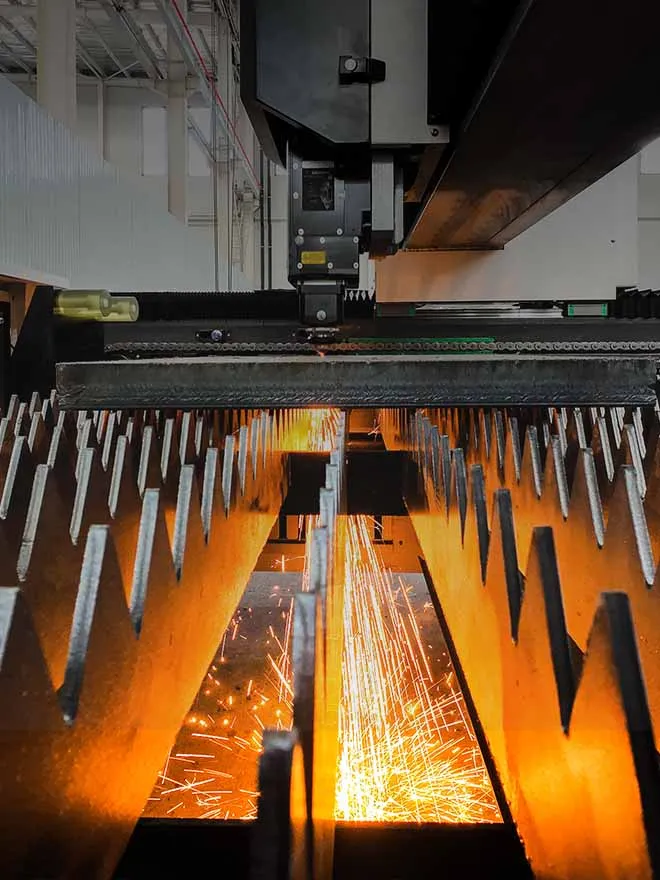
The HAISINN fiber laser cutting equipment successfully supported Chris’s move from conventional plasma cutting to high-precision laser processing.
Improved Cutting Precision
The new processing platform enabled the customer to handle sheet metal parts requiring finer contours and more consistent dimensional quality.
This allowed him to pursue work that had previously been difficult to complete with traditional plasma equipment.
Cleaner Edge Quality
Fiber laser processing provided the improved edge appearance required by higher-value fabrication orders.
Cleaner cutting results also helped reduce dependence on extensive secondary finishing for suitable applications.
Access to Higher-Value Fabrication Orders
With greater cutting capability, Chris expanded beyond basic plasma-cutting work and entered projects with higher requirements for detail, consistency, and finished-part quality.
These opportunities included applications related to:
- Structural steel fabrication
- Mining equipment parts manufacturing
- General sheet metal processing
- Industrial machinery components
- Fabricated metal assemblies
- Stronger Competitive Position
The technology upgrade helped Chris differentiate his business from local workshops still relying primarily on aging plasma systems.
Instead of competing only on basic cutting capacity, he could offer a more advanced processing service supported by stable fiber laser equipment.
Opportunity Within South Africa’s Replacement Cycle
South Africa’s aging installed base of plasma cutting machinery created a clear technology replacement opportunity.
By moving early into fiber laser processing, Chris positioned his business to benefit from growing demand for improved cutting quality and modern production capability.
Better Overall Equipment Value
The rich standard configuration reduced the need to purchase several necessary functions as separate upgrades.
This gave the customer a more complete operating platform from the beginning and improved the clarity of the total equipment investment.
Value Delivered
For Chris, the project provided more than a machine replacement. It established a new technical foundation for business development.
The HAISINN solution delivered:
- A practical transition from plasma to fiber laser cutting
- Improved sheet metal cutting precision
- Cleaner and more consistent edge quality
- Heavy-duty equipment construction
- Controlled component and assembly standards
- A comprehensive standard configuration
- Greater access to higher-value industrial orders
- Stronger differentiation in South Africa’s metal fabrication market
- A production platform suited to future machinery renewal opportunities
Conclusion
Chris’s decision to visit China and compare multiple manufacturers allowed him to evaluate fiber laser technology through real factory conditions, machine construction, practical cutting performance, configuration value, and pricing.
After extensive evaluation, he selected HAISINN for its heavy-duty machine design, strict component manufacturing standards, and feature-rich standard configuration.
The completed project successfully supported his upgrade from plasma cutting to high-precision laser processing. With a more capable and stable production platform, Chris expanded into higher-value sheet metal fabrication work and established a clearer competitive advantage in South Africa’s developing industrial market.
Upgrade from Plasma Cutting to Fiber Laser Processing
HAISINN provides configurable fiber laser cutting equipment for structural steel fabricators, mining equipment manufacturers, general sheet metal processors, and companies replacing aging plasma machinery.
Share your material types, thickness range, sheet dimensions, current cutting process, target components, production volume, and workshop conditions to discuss an appropriate machine configuration.
Contact HAISINN for Technical Consultation and Equipment Selection














 July 30, 2026