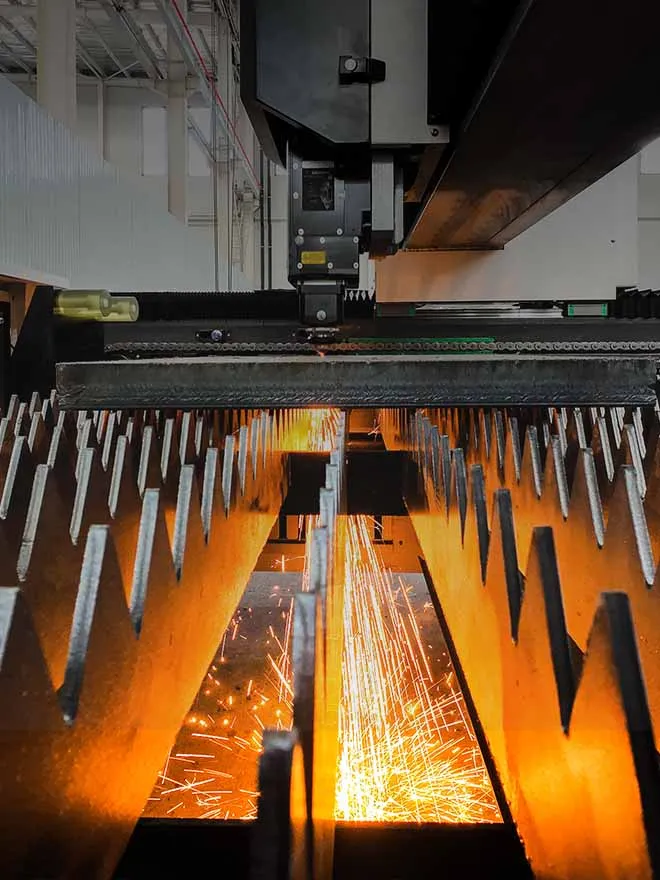
Project Overview
Customer: Medium-sized contract metal fabrication company
Location: Texas, United States
Market: North America
Industry: Agricultural machinery fabrication and structural frame assembly
Previous Process: Manual TIG/MIG welding
Selected Solution: HAISINN Automated Robotic Laser Welding Workstation
Core Configuration: 6-axis industrial robot, laser seam tracking sensor, and customized pneumatic clamping fixtures
Project Objective: Automate repetitive frame welding, stabilize production schedules, and improve joint consistency
Main Result: More stable cycle times, reduced manual fitting, cleaner weld beads, less post-weld grinding, and lower rework rates
Customer Background
The customer is a medium-sized contract metal fabricator based in Texas, USA, specializing in customized agricultural machinery parts and welded structural frames.
Its production includes repeated frame assemblies that must maintain consistent dimensions, weld penetration, and surface quality across medium- and high-volume batches. These components are used in demanding fabrication environments where unstable welding quality can create additional grinding, correction, inspection, and rework.
The company had traditionally relied on experienced TIG and MIG welders for frame fitting and welding. As production volumes increased, however, dependence on skilled manual labor made it more difficult to maintain predictable schedules and consistent output between batches.

The Production Challenge
The customer faced two connected operational pressures: a limited supply of experienced welders in its region and rising hourly labor overhead.
Manual welding remained suitable for prototypes, low-volume parts, and assemblies requiring frequent adjustment, but it became less efficient for repetitive structural-frame production.
The main project requirements included:
- Reducing dependence on experienced TIG/MIG welders
- Automating repetitive frame-welding operations
- Stabilizing cycle times across production batches
- Improving weld consistency from one assembly to the next
- Accommodating minor variations in sheet edges and joint position
- Controlling heat input to reduce frame distortion
- Reducing manual fitting and post-weld grinding
- Lowering rework rates during high-volume production
The customer therefore required more than a standard robot arm. It needed an integrated robotic laser welding cell capable of identifying joint position, securing the frame consistently, and maintaining controlled welding parameters throughout repeated production cycles.
HAISINN Solution
After reviewing the customer’s frame structures, joint conditions, production volume, and quality requirements, HAISINN integrated an Automated Robotic Laser Welding Workstation for the core structural-frame welding line.
The system combined three principal elements:
6-Axis Industrial Robotic Arm
The 6-axis robot provided the movement flexibility required to follow multiple weld paths around structural frame assemblies.
Its programmable motion allowed repeated welding sequences to be executed according to the confirmed frame geometry and production process.

Laser Seam Tracking Sensor
A laser seam tracking sensor was integrated to detect the actual joint position during welding.
This helped the system accommodate minor deviations in sheet edges and assembly position rather than relying entirely on a fixed theoretical path. The tracking function was particularly important for contract fabrication, where small part and fitting variations can occur between batches.
Customized Pneumatic Clamping Fixtures
HAISINN developed pneumatic clamping fixtures around the customer’s frame geometry.
The fixtures supported repeatable positioning, reduced manual holding requirements, and helped keep the assembly stable during robotic welding. Consistent clamping also provided a more reliable foundation for seam tracking and controlled robot movement.
Process Development
1. Frame and Joint Evaluation
The project began with an evaluation of the customer’s structural-frame components, including:
- Joint locations
- Weld sequence
- Assembly dimensions
- Sheet and frame geometry
- Expected edge variation
- Required penetration
- Distortion-sensitive areas
- Production quantity
This information was used to define the robotic path, fixture arrangement, tracking strategy, and welding sequence.
2. Fixture Design
Customized pneumatic fixtures were configured to locate and secure the frame assemblies.
The fixture design focused on reducing manual fitting while maintaining access for the robotic arm and welding head.
3. Seam Tracking Integration
The laser seam tracking sensor was incorporated into the welding process to identify actual seam position and compensate for minor joint deviations.
This improved the workstation’s suitability for repeated contract-manufacturing batches where component tolerances and fitting conditions may not be completely identical.
4. Welding Parameter Optimization
Technical parameters were adjusted according to the customer’s frame structure and welding requirements.
The process focused on:
- Controlled heat input
- Stable weld penetration
- Clean weld-bead formation
- Reduced thermal distortion
- Consistency across repeated cycles
- Adaptation to minor sheet-edge gaps
No single parameter profile was treated as universal. Final settings were matched to the confirmed material, joint design, component thickness, and production conditions.
Production Validation
Representative frame assemblies were used to validate:
- Robot path accuracy
- Fixture repeatability
- Seam tracking response
- Joint consistency
- Penetration performance
- Weld appearance
- Frame distortion
- Post-weld finishing requirements
The workstation was then prepared for repeated production of the customer’s core frame assemblies.

Project Results
The HAISINN robotic laser welding cell successfully automated the customer’s main structural-frame welding operations.
More Stable Cycle Times
Replacing repeated manual welding steps with programmed robotic operation helped stabilize production timing.
The customer gained a more predictable process for high-volume frame runs, making it easier to organize downstream assembly and delivery schedules.
Reduced Reliance on Manual Fitting
Customized pneumatic fixtures and seam tracking reduced the amount of manual positioning required before and during welding.
Operators could load and secure the assembly through a more standardized process instead of relying entirely on individual fitting technique.
Consistent Weld Penetration
The optimized welding process delivered consistent penetration depth across repeated frame assemblies.
This improved batch-to-batch uniformity and reduced the variation commonly associated with changes in manual operator technique.
Cleaner Weld Beads
The automated laser welding process produced clean, repeatable weld beads on the validated frame applications.
The improved weld appearance reduced the amount of corrective finishing required after welding.
Less Post-Weld Grinding
Because the weld beads were more consistent and visually cleaner, the customer significantly reduced post-weld grinding labor.
This shortened the total frame-production workflow and allowed employees to focus on loading, inspection, assembly, and other higher-value tasks.
Lower Rework Rates
Consistent clamping, seam detection, programmed movement, and controlled heat input helped lower rework rates during high-volume production.
Fewer assemblies required correction due to irregular weld paths, inconsistent penetration, or excessive distortion.
Reduced Frame Distortion
The optimized welding sequence and controlled heat input minimized distortion in the validated structural-frame applications.
This improved dimensional consistency and reduced the need for post-weld straightening or adjustment.
Equipment Value for the Customer
The project gave the Texas manufacturer a practical path from labor-intensive manual welding to controlled industrial automation.
The HAISINN solution delivered:
- Automated repetitive structural-frame welding
- Six-axis movement for multi-directional weld paths
- Laser seam tracking for minor joint-position variation
- Customized pneumatic fixtures for repeatable loading
- More stable production cycle times
- Consistent penetration and weld-bead quality
- Reduced dependence on experienced manual welders
- Less post-weld grinding
- Lower rework during high-volume runs
- Improved production planning for agricultural machinery orders
Conclusion
By integrating the HAISINN Automated Robotic Laser Welding Workstation, the customer successfully automated core welding processes for agricultural machinery frames and structural assemblies.
The combination of a 6-axis industrial robot, laser seam tracking, customized pneumatic clamping, and application-specific parameter optimization enabled the company to stabilize cycle times, reduce manual fitting, and improve weld consistency across production batches.
The completed project provided a more reliable foundation for high-volume frame assembly while reducing post-weld grinding, controlling distortion, and lowering rework.
Automate Your Repetitive Frame-Welding Process
HAISINN provides configurable robotic and collaborative robot welding systems for agricultural machinery, metal frames, fabricated assemblies, industrial equipment, and repeated batch production.
Share your material, thickness, joint design, frame drawings, production volume, current welding process, acceptable gap range, and required weld quality to discuss a suitable robotic laser welding cell.
Contact HAISINN for Robotic Welding Consultation














 July 30, 2026