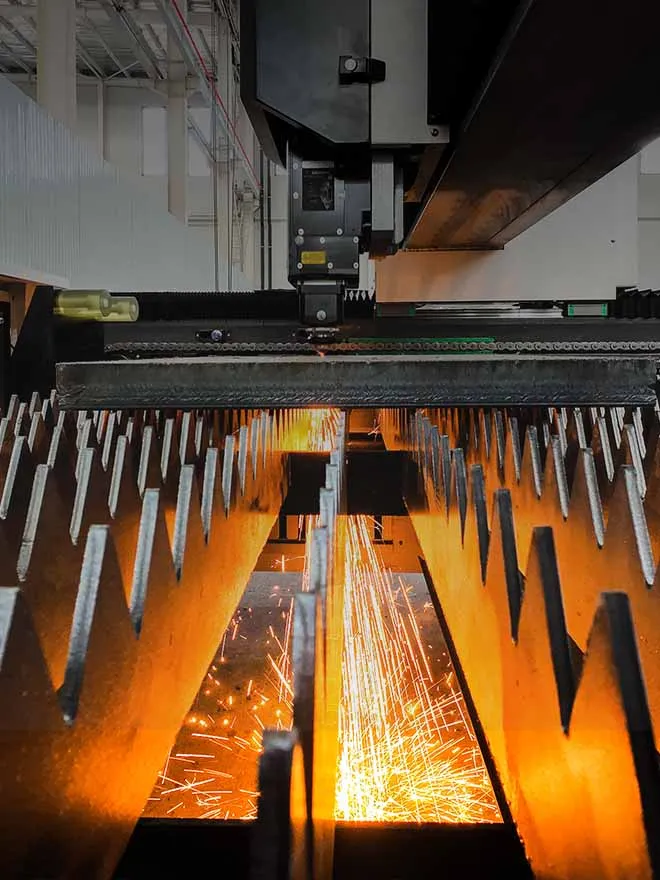
Modern sheet metal manufacturers face growing pressure to improve production efficiency while maintaining cutting precision, workplace safety, and environmental control. Selecting the right macchina per il taglio laser a fibra requires more than comparing laser power or cutting speed.
Machine acceleration, enclosure design, structural stability, and regulatory requirements all influence equipment selection.
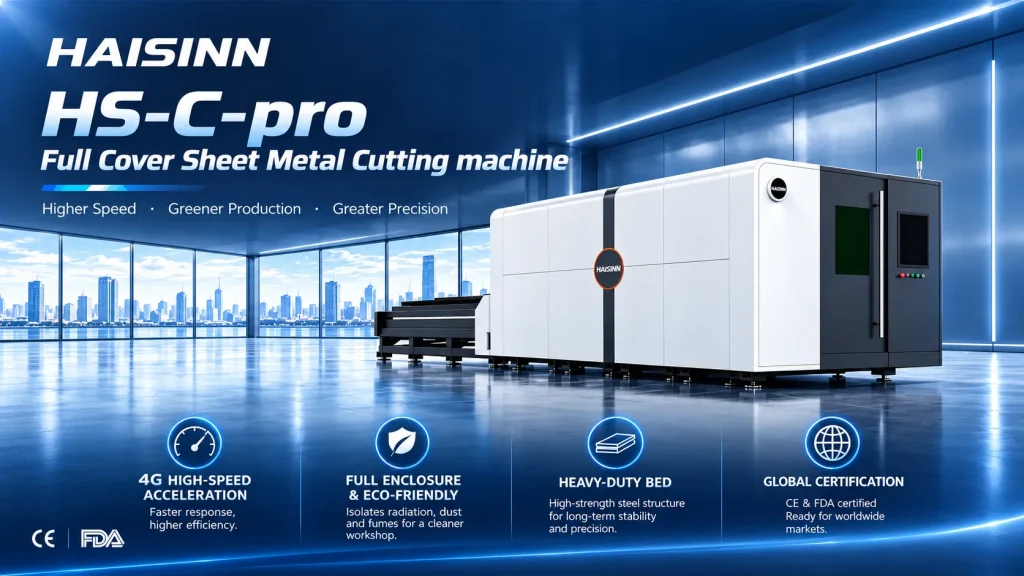
The new HAISINN HS-C-Pro Full Enclosure Fiber Laser Cutting Machine brings these considerations together through four key features: up to 4G acceleration, a fully enclosed cutting structure, a heavy-duty welded steel bed, and CE and FDA-related certification information provided by HAISINN.
This article explains what these features mean for industrial buyers and how to evaluate their value in sheet metal production.
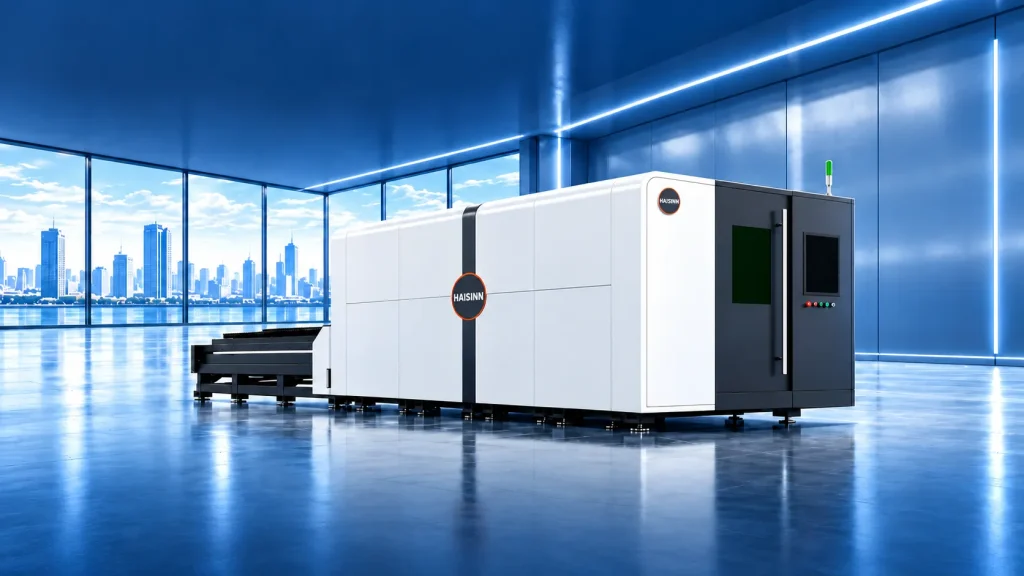
Che cos’è una macchina per il taglio laser a fibra con involucro completo?
A macchina per il taglio laser a fibra con involucro completo is an industrial metal-cutting system that uses a focused fiber laser beam to process sheet metal within an enclosed cutting area.
Unlike an open-frame machine, a fully enclosed design provides a physical barrier around the cutting process. This helps control exposure to laser radiation and contain cutting-related dust and fumes when combined with appropriate safety and extraction systems.
For manufacturers, the main considerations are cutting capability, operating efficiency, workshop protection, and long-term equipment stability.
The HAISINN HS-C-Pro is designed around these requirements, combining an enclosed structure with high-speed motion capability and a reinforced machine bed.
Why Does High-Speed Acceleration Matter in Laser Cutting?
Machine acceleration affects how quickly a cutting system changes its movement speed, particularly during frequent starts, stops, and directional changes.
La HAISINN HS-C-Pro supports acceleration of up to 4G, one of the main performance features highlighted in its product launch.
Faster Dynamic Response
During sheet metal processing, a CNC laser cutting machine may need to perform numerous positioning movements and changes in direction.
Higher acceleration capability can help reduce the time required for these movements, depending on the cutting program, machine configuration, and operating conditions.
This can be particularly relevant when processing parts with complex cutting paths.
What Does 4G Mean for Production Efficiency?
A 4G acceleration rating describes the machine’s acceleration capability. It does not mean the machine cuts four times faster than another laser cutter.
Actual production output also depends on:
- Material type and thickness
- Laser power and cutting parameters
- Part geometry and cutting path
- Piercing time and auxiliary movements
- Material handling and production organization
For industrial buyers, acceleration should therefore be evaluated alongside the complete cutting process rather than treated as a standalone productivity guarantee.
How Does a Full Enclosure Improve Laser Cutting Safety and Workshop Conditions?
Industrial laser cutting generates intense laser radiation, heat, fumes, and airborne particles. Managing these hazards is an important consideration when selecting equipment for a metal fabrication workshop.
La HS-C-Pro features a fully enclosed cutting structure designed to provide a controlled processing environment.
Protection Around the Cutting Area
The enclosure creates a physical barrier between the cutting operation and the surrounding workspace.
Its purpose is to help limit exposure to hazards associated with the laser cutting process.
However, effective protection depends on the complete machine safety design, correct operation, and appropriate maintenance.
Cleaner Sheet Metal Production
Laser cutting can produce smoke, fumes, and metal particles that must be managed through suitable extraction and filtration arrangements.
An enclosed cutting environment helps contain these emissions so they can be controlled more effectively.
For factory operators, this makes enclosure design an important consideration when planning workshop ventilation and working conditions.
The specific extraction equipment and safety configurations supplied with an HS-C-Pro should be confirmed during machine selection.
Why Is a Heavy-Duty Welded Bed Important for Cutting Precision?
The machine bed provides the structural foundation for the cutting system.
During operation, repeated acceleration, movement, and mechanical loads place demands on the machine structure. Adequate rigidity is important for maintaining consistent positioning and supporting long-term operation.
La HAISINN HS-C-Pro uses a high-strength welded steel bed designed for industrial sheet metal cutting.
Structural Stability During Operation
A reinforced welded structure provides mechanical support for the cutting system.
This is particularly relevant for equipment designed to operate with frequent movement and high dynamic loads.
Supporting Consistent Cutting Quality
Machine rigidity is one of several factors that influence cutting consistency.
A stable structure helps support accurate motion, while actual cutting results also depend on the motion-control system, laser source, cutting head, material characteristics, and process parameters.
For buyers evaluating a sheet metal laser cutting machine, structural design should be considered together with cutting samples and verified machine performance data.
Full Enclosure vs. Open-Frame Laser Cutting Machines: What Is the Difference?
Both enclosed and open-frame fiber laser cutting machines are used in industrial metal processing. The appropriate choice depends on the factory’s operating requirements.
| Evaluation Factor |
Full Enclosure Machine |
Open-Frame Machine |
| Cutting area |
Surrounded by an enclosure |
More directly accessible |
| Laser protection |
Physical enclosure supports hazard control |
Requires suitable alternative protective measures |
| Dust and fume management |
Enclosure helps contain emissions |
Extraction arrangements must account for the open structure |
| Material access |
Depends on door and machine layout |
Generally offers more direct access |
| Factory planning |
Requires evaluation of enclosure, access, and ventilation |
Requires evaluation of exposed cutting-area safety |
A full enclosure is particularly relevant to buyers who prioritize controlled cutting environments and physical separation of the cutting process.
However, neither design should be evaluated on appearance alone. The complete safety system, cutting capability, operating workflow, and maintenance access remain important.
What Should International Buyers Know About CE and FDA Requirements?
Regulatory compliance is an important part of purchasing industrial laser equipment for international markets.
HAISINN’s HS-C-Pro product materials identify CE and FDA certification as a key selling point for the new model.
For buyers in Europe and North America, the important next step is to review the documentation applicable to the exact machine configuration and destination market.
CE Requirements
CE marking relates to applicable European Union product requirements. Buyers should review the relevant declaration of conformity, technical documentation, and applicable standards.
FDA Requirements
In the United States, certain laser products are subject to FDA radiation-emitting product regulations and associated reporting or compliance requirements.
Buyers should verify the relevant documentation and regulatory status rather than assume that an FDA reference represents a general product approval.
Important: Certification information should be reviewed against the specific machine and destination requirements. CE marking or FDA-related documentation does not automatically guarantee unrestricted market entry.
What Are the Main Advantages of the HAISINN HS-C-Pro?
The HS-C-Pro combines four features that address different priorities in industrial sheet metal processing.
| Confirmed Product Feature |
Technical Purpose |
Potential Buyer Value |
| Up to 4G acceleration |
Supports faster dynamic movement |
Helps optimize motion-related processing time |
| Full enclosure |
Separates and contains the cutting environment |
Supports workplace protection and emission control |
| High-strength welded steel bed |
Provides structural support |
Supports machine stability during operation |
| CE and FDA-related credentials stated by HAISINN |
Addresses international compliance considerations |
Provides a basis for reviewing market-specific documentation |
These features should be assessed as part of the complete machine configuration.
For example, high acceleration may improve motion performance, but actual cutting productivity still depends on the selected laser power, processing requirements, and material-handling workflow.
Similarly, an enclosed design supports workshop protection, but buyers must still confirm the safety devices and extraction systems included with the machine.
How Should Manufacturers Evaluate the HS-C-Pro Before Purchasing?
Choosing an industrial metal laser cutting machine requires matching the equipment to actual production needs.
The HS-C-Pro’s published launch information highlights its enclosure, acceleration, welded bed, and international compliance positioning. Buyers should request additional configuration details before making a final selection.
Confirm Your Material and Cutting Requirements
Start with the material types, thickness range, sheet dimensions, and part designs processed in your workshop.
These factors help determine the appropriate laser power, working area, and cutting configuration.
Evaluate Production Requirements
Review expected production volume, typical part complexity, and operating schedules.
For high-volume production, total cycle time matters more than acceleration alone.
Review Workshop Conditions
Consider available installation space, ventilation, material movement, and operator access.
A full enclosure should fit the factory’s workflow without creating unnecessary handling difficulties.
Verify Technical Performance and Documentation
Before purchasing, request confirmation of the selected machine’s specifications, cutting samples, safety configuration, and applicable compliance documents.
This approach helps ensure that the machine matches both production requirements and local operating conditions.
Who Should Consider the HS-C-Pro Fiber Laser Cutting Machine?
The HAISINN HS-C-Pro is positioned for industrial buyers evaluating enclosed sheet metal cutting equipment.
Potential buyers include sheet metal fabrication companies, metal processing workshops, machinery manufacturers, and factories seeking to upgrade their cutting equipment.
The model may be worth evaluating when the purchasing priorities include:
- High-speed machine movement
- An enclosed cutting environment
- Heavy-duty machine construction
- International equipment compliance considerations
Final suitability depends on the required material range, processing capacity, factory conditions, and confirmed equipment configuration.
Conclusion: A New Option for Enclosed Sheet Metal Laser Cutting
Selecting the right fiber laser cutting machine for metal requires a balance between motion performance, structural stability, workplace protection, and practical production needs.
The HAISINN HS-C-Pro brings together up to 4G acceleration, a fully enclosed cutting structure, and a heavy-duty welded steel bed in a machine designed for industrial sheet metal processing.
For manufacturers considering an equipment upgrade, the HS-C-Pro offers a configuration worth evaluating against their specific cutting requirements.
Contatta HAISINN with your material type, thickness range, sheet size, and production needs to discuss the HS-C-Pro and request suitable machine configuration information.
Domande frequenti
What is the HAISINN HS-C-Pro?
The HAISINN HS-C-Pro is a full enclosure fiber laser cutting machine developed for industrial sheet metal processing. Its highlighted features include up to 4G acceleration, a fully enclosed cutting structure, and a high-strength welded steel bed.
What does 4G acceleration mean in a fiber laser cutting machine?
4G refers to the machine's acceleration capability during movement. It can support faster dynamic response, but actual cutting speed and production output depend on material, laser power, cutting paths, and processing parameters.
Is a full enclosure fiber laser cutting machine safer than an open-frame machine?
A full enclosure provides a physical barrier around the cutting area and can help control exposure to laser radiation and cutting emissions. Overall safety still depends on the complete protective system, extraction equipment, and correct operation.
Does the HS-C-Pro support cleaner production?
The HS-C-Pro uses a fully enclosed cutting structure designed to help contain dust and fumes generated during laser cutting. Effective emission control also requires appropriate extraction and ventilation arrangements.
What materials and thicknesses can the HS-C-Pro cut?
The available launch materials do not specify a complete material list or cutting-thickness range. These capabilities should be confirmed according to the selected laser power and machine configuration.
What certifications does the HS-C-Pro have?
HAISINN's product launch materials state that the HS-C-Pro has CE and FDA credentials. International buyers should request the corresponding documentation and verify its applicability to their machine configuration and destination market.
How can I choose the right HS-C-Pro configuration?
Provide the material type, maximum thickness, sheet dimensions, production volume, and factory requirements. These details can be used to discuss a suitable cutting configuration with HAISINN.












 October 10, 2026