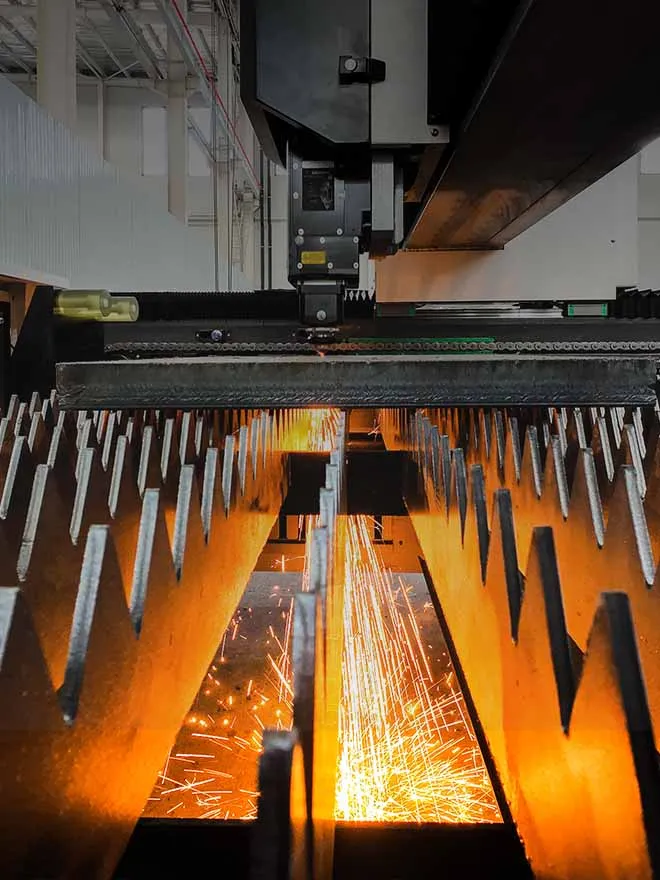
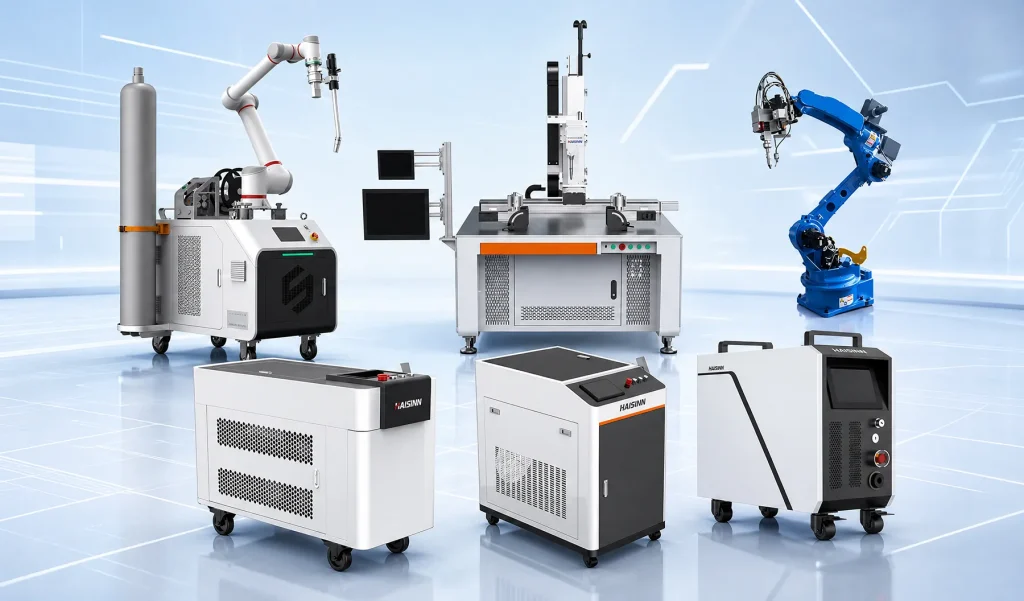
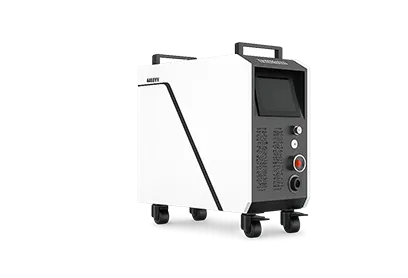
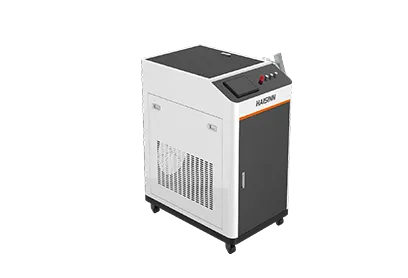
A stainless steel laser welding machine joins stainless sheet and tube with a focused laser beam, producing narrow seams with low heat input compared with arc welding. HAISINN’s HCW Series offers 1,500, 2,000 and 3,000 W options, and can also clean seams and cut, depending on the ordered configuration.
What the machine actually consists of
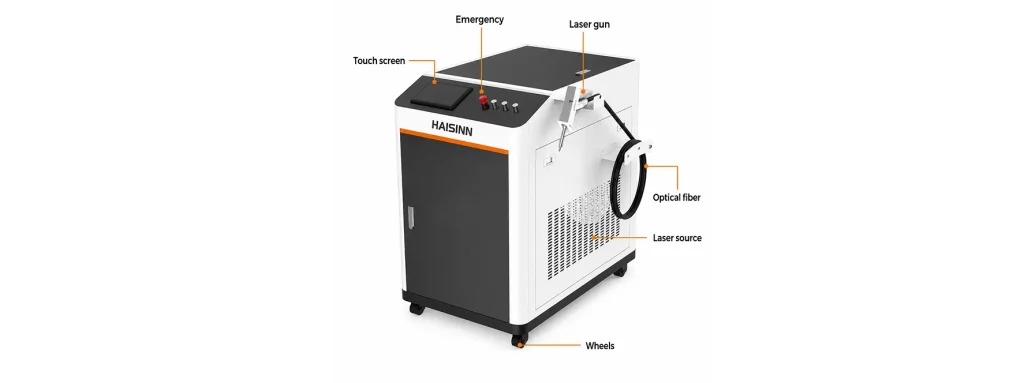
A laser welding system has four working parts: a laser source, a fiber that carries the beam, a welding head that focuses it, and a shielding-gas supply. Motion comes from either the operator’s hand or a fixed workstation or robot. The beam concentrates energy in a spot far smaller than a TIG arc, so the weld pool is narrow and the surrounding metal stays cooler.
For stainless, that matters because the metal conducts heat poorly. Heat from a wide arc stays where it lands, and thin panels warp. A narrow, fast laser seam limits that spread, which is why stainless enclosures, food-equipment housings and steam equipment are common candidates for this process.\
Where stainless behaves well, and where it catches people out
The common misconception: “the laser is forgiving.” It isn’t, at least on joint fit-up. A TIG welder can feed filler wire to bridge a gap. A laser beam that small needs edges that meet closely, so the quality of the upstream cutting and bending decides whether the weld looks clean. This is one reason a supplier covering both cutting and welding can be useful: the edge quality coming off the cutter is part of the welding setup.
Heat tint. Discoloration beside the seam appears when the weld zone isn’t fully covered by shielding gas while it is still hot. Tint is more than cosmetic on corrosion-critical parts, because it can reduce corrosion resistance until it is removed and the surface is passivated. This is the practical reason the HCW’s seam-cleaning function is worth asking about.
Grade and thickness. The HCW pages give no thickness ceiling per power option, and no stainless grade list. Anyone quoting “up to X mm at 2,000 W” without stating grade, gas and quality criteria is giving you a number you can’t hold them to.
Laser welding vs. TIG on stainless sheet
Compared with TIG-based joining, which is the usual baseline in general fabrication shops, the trade-offs look like this:
| Czynnik |
Laser Welding |
TIG Welding |
| Heat Input |
Low, localized |
Higher, wider heat-affected area |
| Gap Tolerance |
Tight; needs good fit-up |
More forgiving, filler wire available |
| Post-Weld Finishing |
Often less grinding, depends on joint and gas |
Frequently needs blending and cleaning |
| Operator Skill |
Setup and parameter discipline |
Manual dexterity and torch control |
| Safety Infrastructure |
Laser-safety controls required |
Arc and fume controls |
The HCW Series: what HAISINN publishes
The HCW is sold as a multi-functional laser system. Its public data is short, and the gaps matter as much as the figures.
| Item |
Published Information |
Status |
| Laser Power Options |
1,500 W, 2,000 W, 3,000 W |
Published |
| Integrated Functions |
Laser welding, surface cleaning, weld-seam cleaning, laser cutting |
Package depends on ordered configuration |
| Weldable Thickness per Power Option |
Not published |
Confirm via sample test |
| Stainless Grades Validated |
Not published |
Confirm via sample test |
| Cooling, Gas Requirements, Seam Width |
Not published |
Do potwierdzenia |
| CE / FDA |
Company-level claims on the website only |
Model-specific documents required |
| Gwarancja |
Public statements vary across pages |
Confirm in the contract |
Five steps to specify a stainless welding system
- Record your parts. Note the stainless grade, sheet or tube thickness range, joint types (butt, lap, corner) and typical seam length.
- Decide the function package. If seams need cleaning after welding, or the same station will cut, say so in the inquiry, since the HCW’s function set is configuration-dependent.
- Pick a power option against your thickest joint and required speed. The three published steps are 1,500, 2,000 and 3,000 W. Higher power isn’t automatically better for thin stainless, where heat control is the goal.
- Ask for a sample weld on your own joint. Specify the grade, shielding gas and the acceptance criteria (penetration, tint level, distortion limit), then check the result yourself.
- Request the paperwork for your exact configuration. That means the CE declaration or certificate, any FDA-related records, and the warranty terms in writing.
Safety and compliance references
Laser processing machines fall under ISO 11553-1:2020 for laser safety requirements, and IEC 60825-1:2014 covers laser classification and labeling. IEC TR 60825-14:2022 is a user’s guide covering workplace procedures and training. If you order a handheld configuration, ISO 11553-2:2007 applies to hand-held laser processing devices; check its current status and regional adoption. For machines placed on the EU market, Regulation (EU) 2023/1230 replaces Directive 2006/42/EC from January 20, 2027, so ask which framework your unit’s placement date falls under.
These standards are references for your review. Their listing here does not mean any HAISINN machine has been tested to them.
Najczęściej zadawane pytania
Can one machine both weld and clean stainless seams?
The HCW Series is described as integrating laser welding, surface cleaning and weld-seam cleaning, with the function package set by the ordered configuration.
Which HCW power should I choose for 304 stainless?
HAISINN publishes 1,500, 2,000 and 3,000 W options but no thickness ceiling per power step. Request a sample weld on your joint at your target thickness before deciding.
Is the HCW CE or FDA certified?
HAISINN's website makes company-level CE and FDA claims. Certificate numbers and model-specific coverage are not publicly displayed, so ask for the documents for your exact configuration.
How much does a stainless steel laser welding machine cost?
Prices are quoted per project. The quotation depends on power, materials, automation level, components, destination market and service scope.












 September 30, 2026