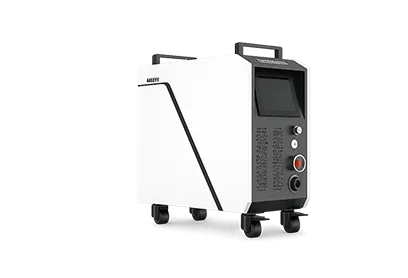
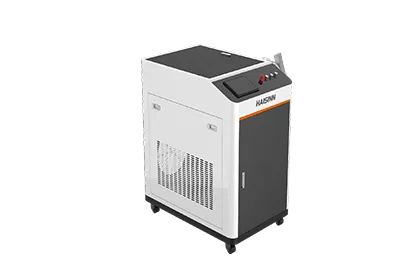
Air-cooled portable laser welders, such as HAISINN’s AW Series at 800 W to 2,000 W, drop the separate water chiller, leaving one fewer unit to move, fill and drain. Water-cooled systems add a chiller but are the usual route to higher power and longer continuous welding. The right choice depends on power needs, duty cycle and ambient temperature.
What the Cooling Method Actually Changes
A fiber laser source turns part of its input power into heat, and that heat has to leave the source and the welding head for output to stay stable. A water-cooled system pumps coolant through a chiller. An air-cooled system moves heat out with fans and heat sinks inside the cabinet.
That single design choice decides most of what a buyer will notice later: how many units arrive on site, what has to be refilled, what happens in a hot workshop and how long the welder can run before it needs a pause.

Air-Cooled vs Water-Cooled: Side-by-Side
| Dimensione |
Air-cooled handheld welder |
Water-cooled handheld welder |
| Separate chiller unit |
No |
Yes, either integrated in the cabinet or standalone |
| Coolant handling |
Nessuno |
Filling, level checks, coolant replacement, draining before transport |
| Freezing risk in cold sites or during shipping |
No coolant to freeze |
Coolant must be protected or drained |
| Sensitivity to high ambient temperature |
Higher; heat rejection depends on surrounding air |
Lower within the chiller’s rated range |
| Typical power ceiling |
Lower; HAISINN’s AW Series tops out at 2,000 W |
Common choice for higher-power sources |
| Continuous welding at full power |
Check the rated duty cycle |
Generally better suited to long continuous runs |
| Routine maintenance focus |
Air filters, fan intakes, dust management |
Coolant quality, filters, chiller condition |
| Moving between work areas |
Fewer components to relocate |
Chiller and hoses move with the machine |
| Setup at a new location |
Power, shielding gas, laser-controlled area |
Same, plus chiller placement and coolant check |
The table compares the two cooling categories in general. Individual machines vary, so the duty cycle and ambient range on the specific datasheet override any rule of thumb.
Where Air-Cooled Portable Welders Win
Moving the welder to the work
For shops without fixed welding stations, the welder often goes to the part: a large enclosure on the floor, a frame on a fixture, a site repair. Without a chiller and coolant lines, there is less to roll across the shop and less to reconnect each time.
Cold storage and shipping
A water-cooled system left in an unheated building or shipped in winter needs freeze protection. An air-cooled unit has no coolant circuit to protect, which simplifies storage between jobs and transport to remote sites.
Smaller setup checklist
Every move of a water-cooled system brings a coolant check and hose inspection. For a “mini laser welding machine” bought for occasional repairs or short production runs, removing that routine is often worth more than extra power that would sit unused.
Where Water-Cooled Systems Still Make More Sense
- High power requirements. Within HAISINN’s published welding range, 3,000 W options appear in the DW workstation and HCW multi-functional series, while the Serie AW stops at 2,000 W. If your thickest joints or travel speeds need more than 2,000 W, an air-cooled handheld unit is the wrong starting point.
- Long continuous shifts. If one operator welds for most of a shift with few breaks, the duty cycle at rated power matters more than portability.
- Hot workshops. Air cooling depends on the surrounding air. In a workshop that runs hot in summer, check the maximum ambient temperature on the datasheet and whether output is reduced near that limit.
- Dusty environments. Grinding dust and metal particles load air filters quickly. Air-cooled units in these areas need a filter-cleaning schedule, or cooling performance will suffer.
AW Series Specifications
The AW Series is HAISINN’s air-cooled handheld laser welding machine.
| Parametro |
Published AW Series information |
| Cooling method |
Air-cooled |
| Format |
Handheld laser welding |
| Power options |
800 W, 1,200 W, 1,500 W, 2,000 W |
| Duty cycle, weight, wire feeder, ambient range |
Not publicly disclosed; confirm in quotation |
Choosing within the range. The 800 W and 1,200 W options suit thin sheet and repair work where portability is the priority. The 1,500 W and 2,000 W options extend the thickness range and travel speed. Achievable penetration depends on material, joint design, shielding gas and the weld quality you accept, so test welds on your own parts are the only dependable reference.

Two Misconceptions Worth Correcting
“Air-cooled means maintenance-free.” It means no coolant maintenance. Fans, filters and air intakes still need regular cleaning, and the protective lens in the welding head is a consumable on both types.
“Portable means it can weld anywhere.” The welder still needs a suitable power supply, shielding gas and a controlled area where laser radiation cannot reach bystanders. Handheld laser welding needs more attention to this than enclosed systems, because the beam is guided by the operator rather than a fixed enclosure.
How to Choose Between Air-Cooled and Water-Cooled
- List your materials and the thickest joint you weld regularly, not occasionally.
- Estimate how many minutes per hour the welder actually fires during a typical shift.
- Record the highest and lowest temperatures your workshop or job sites reach.
- Count how often the welder needs to move between areas or sites each week.
- Ask the supplier for rated duty cycle at stated ambient temperature for each candidate configuration.
- Request test welds on your own material and joint geometry at the quoted power level.
- Confirm warranty period and compliance documentation for the exact configuration in the sales contract.
Domande frequenti
Is an air-cooled laser welder powerful enough for production work?
For thin to medium sheet within its power range, often yes. HAISINN's AW Series offers 800 W to 2,000 W. For sustained high-power welding, check the rated duty cycle first.
Do air-cooled laser welders overheat in summer?
They are more sensitive to ambient temperature than water-cooled systems. Check the maximum rated ambient temperature and plan breaks or ventilation for hot workshops.
What maintenance does an air-cooled handheld welder need?
Regular cleaning of air filters and intakes, inspection of the fiber cable and replacement of the protective lens. It removes coolant maintenance, not all maintenance.
What is the difference between a portable and a mini laser welding machine?
The terms overlap. Both usually describe compact handheld welders; "mini" tends to refer to lower-power units for light repair and thin sheet.
How thick can a 2,000 W handheld laser welder weld?
It depends on material, joint design, shielding gas and quality requirements.














 4 novembre 2026