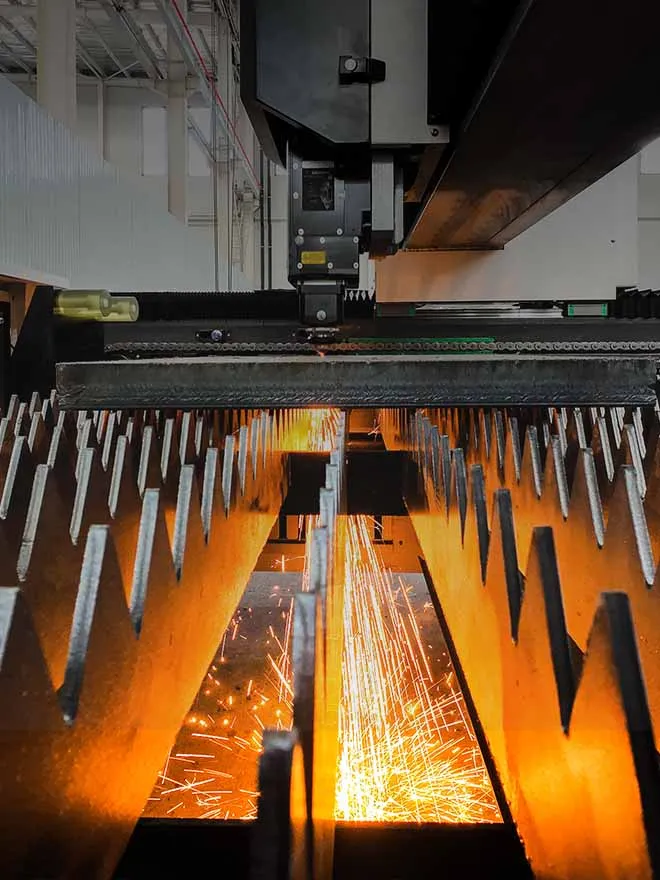
Choosing a laser cutting machine based only on laser power or purchase price can result in an expensive mismatch between the equipment and the factory’s actual production.
A job shop processing mixed thin and medium sheet orders has different requirements from a structural fabricator cutting large plates. A factory producing both sheets and tubes may need a different machine again. Working area, material type, thickness distribution, production volume, loading frequency, factory space, automation requirements, and future capacity all influence the correct configuration.
A fiber laser cutting machine should be selected according to the materials you process, normal thickness range, sheet dimensions, production volume, required machine structure, automation level, factory layout, and investment plan. Higher laser power or a larger working area is not automatically better. The best machine is the one that matches your real production workflow.

What Is a Fiber Laser Cutting Machine?
A fiber laser cutting machine is a CNC-controlled industrial system that uses a focused fiber laser beam to cut suitable metal workpieces according to programmed paths.
For sheet-metal processing, the system normally combines several major elements:
- Fiber laser source
- Laser cutting head
- CNC control system
- Machine bed
- Gantry and motion system
- Servo system
- Working platform
- Cooling system
- Assist-gas system
- Dust and fume extraction
- Safety system
- Optional material-handling equipment
The CNC controller coordinates movement while the laser cutting head follows the programmed geometry.
This allows a CNC laser cutting machine to produce different contours, holes, slots, openings, panels, brackets, structural parts, and fabricated components without requiring a dedicated mechanical cutting tool for every shape.
For industrial buyers, however, the important question is not simply:
What is a fiber laser cutter?
The more useful question is:
Which fiber laser cutter configuration matches my production?
That requires understanding the workpieces before comparing machines.

What Materials Can a Fiber Laser Cutting Machine Cut?
A laser cutting machine for metal is commonly selected for industrial sheet-metal processing.
HAISINN’s current sheet-metal product directions cover applications including:
- Carbon steel
- Stainless steel
- Aluminum
- General sheet-metal fabrication
The exact cutting capability depends on the selected machine configuration.
Carbon Steel
Carbon steel is widely used in:
- Machinery manufacturing
- Structural components
- Agricultural machinery
- Construction equipment
- General fabrication
- Industrial frames
When selecting a laser steel cutting machine, buyers should consider not only the maximum steel thickness but also the thicknesses that dominate daily production.
A factory that occasionally cuts a thick steel part but normally processes much thinner material may not need the same machine configuration as a heavy-fabrication shop.
Stainless Steel
Stainless steel is common in:
- Industrial equipment
- Electrical cabinets
- Enclosures
- Food-processing equipment
- Fabricated components
- Metal products
The required edge quality, material thickness, production volume, and downstream process should be considered when configuring the machine.
Aluminum
Fiber laser technology can also be used for suitable aluminum applications.
Buyers should confirm:
- Aluminum grade
- Thickness range
- Part geometry
- Required edge quality
- Production volume
Material compatibility should always be evaluated using the proposed configuration rather than a generic cutting chart copied from another machine.
What Type of Laser Cutting Machine Do You Need?
The phrase metal laser cutting machine covers several very different equipment structures.
Selecting the correct structure can be just as important as selecting laser power.
| Machine Type |
Main Production Direction |
Buyer Should Consider |
| Single-Platform Laser Cutting Machine |
Standard sheet processing |
Loading frequency, budget, and production rhythm |
| Exchange-Table Laser Cutting Machine |
Higher-volume sheet production |
Loading and unloading interruption |
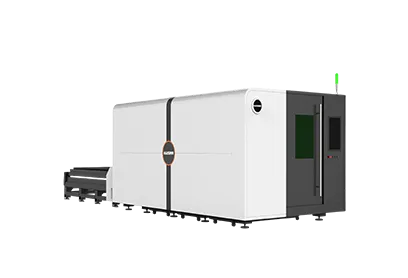
| Fully Enclosed Laser Cutting Machine |
Enclosed processing environment |
Safety and workshop requirements |
| Large-Format Laser Cutting Machine |
Oversized sheets and long plates |
Floor space and material handling |
| Coil-Fed Laser Cutting Machine |
Continuous coil processing |
Repetitive production and automation |
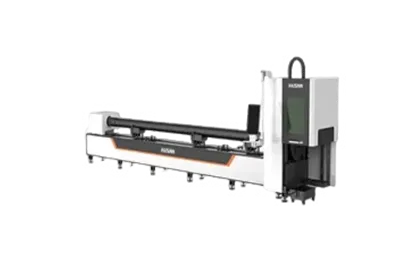
| Tube Laser Cutting Machine |
Tubes and profiles |
Tube size, length, chuck, and loading |
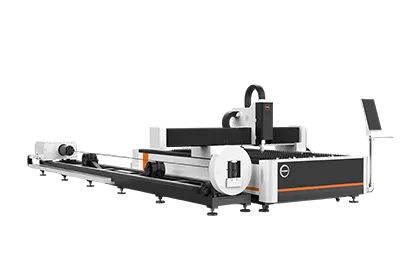
| Sheet-and-Tube Laser Cutting Machine |
Mixed flat-sheet and tube processing |
Production mix and simultaneous capacity |
HAISINN’s product system includes these different directions rather than relying on one universal laser cutter for every manufacturing requirement.

Single-Platform Machines
A single-platform machine provides a straightforward sheet-processing structure.
It can be appropriate where production volume, loading frequency, and workflow do not justify a more complex material-exchange system.
Exchange-Table Machines
An exchange table allows one platform to be used for cutting while another participates in loading or unloading operations according to the machine workflow.
This structure becomes more relevant when repeated material handling would otherwise interrupt machine utilization.
Fully Enclosed Machines
A fully enclosed structure can be considered where buyers place greater importance on process containment and workshop organization.
However, buyers should confirm the exact enclosure, extraction, interlock, and safety configuration for the proposed machine.
Large-Format Machines
A large format laser cutting machine is intended for buyers working with oversized plates or long metal sheets.
The benefit comes from matching the working area to real material dimensions.
Buying a large-format machine without a production need can increase:
- Equipment investment
- Factory footprint
- Material-handling requirements
- Loading complexity
How Much Laser Power Should You Choose?
Laser power is one of the most visible specifications on a fiber laser cutting machine, but it should not be selected in isolation.
Higher power may expand processing capability or improve productivity in suitable applications, but the correct power depends on several factors.
Material Type
Carbon steel, stainless steel, aluminum, and other metals do not behave identically during cutting.
Thickness Distribution
Do not look only at the maximum thickness.
Prepare a production distribution such as:
- Frequently processed thicknesses
- Medium-frequency thicknesses
- Occasional maximum thickness
This gives a manufacturer a more realistic basis for equipment selection.
Production Volume
A factory processing occasional batches has different requirements from a multi-shift production plant.
Required Cutting Quality
Required edge condition and downstream processes can influence the preferred process configuration.
Investment and Operating Cost
Higher laser power can influence more than the initial machine quotation.
Buyers should also consider the complete production system and operating requirements.
The correct question is therefore not:
What is the highest laser power I can afford?
It is:
What laser power gives the right balance between my normal workload, required productivity, operating conditions, and investment?
What Working Area Should a Fabrication Shop Select?
Working area determines the maximum sheet dimensions that can be processed on the machine.
But its impact extends much further.
A larger industrial metal laser cutting machine may require:
- More floor space
- Larger loading zones
- More unloading space
- Different lifting equipment
- Different material storage
- More workshop planning
Before choosing the working area, check the actual sheet sizes purchased by your factory.
Ask:
- What are our most common sheet dimensions?
- What is the largest normal sheet?
- Do we regularly process oversized plates?
- Can standard stock be nested efficiently?
- How will sheets be loaded?
- How will finished parts be removed?
- Is there enough space around the machine?
A larger working area only creates value when the factory can use it.
Single Platform vs Exchange Table: Which Is Better?
Neither structure is universally better.
The correct choice depends on production volume and material-handling workflow.
Single Platform
A single platform laser cutting machine can be attractive where:
- Loading frequency is moderate
- Production batches are flexible
- Workshop space is limited
- Simpler material flow is preferred
- Investment needs to remain focused on essential cutting capability
Exchange Table
An exchange table laser cutting machine becomes more relevant when:
- Production volume is higher
- Sheets change frequently
- Loading interrupts cutting
- Machine utilization is important
- Operators repeatedly wait for the cutting area to become available
The decision should be based on how much time the factory spends handling materials between cutting cycles.
Do not purchase an exchange table simply because it appears more advanced.
If the production schedule does not use the additional workflow capability, the investment may not generate meaningful manufacturing value.
Should You Choose Sheet, Tube, or Sheet-and-Tube Cutting?
Many factories search broadly for a laser CNC cutting machine without first separating the workpiece type.
This creates a major equipment-selection risk.
Sheet Metal Laser Cutting Machine
Choose a sheet metal laser cutting machine when the production workload is mainly flat metal sheets.

Typical considerations include:
- Sheet dimensions
- Material type
- Thickness range
- Working area
- Loading method
- Production volume
Tube Laser Cutting Machine
A laser tube cutting machine is specifically designed for tubular stock.
Tube processing requires factors that do not apply to normal flat-sheet cutting:
- Tube diameter
- Tube length
- Tube profile
- Tube weight
- Chuck configuration
- Tube support
- Rotation
- Tail material
- Automatic loading
Different HAISINN tube-machine directions include economical, small-diameter, full-cover, heavy-duty, and automatic-loading systems.

A small tube laser cutting machine, for example, should only be selected where the actual tube dimensions fit that product direction.
Sheet-and-Tube Laser Cutting Machine
A combined machine can be considered when a factory genuinely processes both flat sheets and tubular stock.
Before purchasing, ask:
- What percentage of production is sheet?
- What percentage is tube?
- Do sheet and tube jobs need to run at the same time?
- How frequently does production switch?
- Is floor-space efficiency important?
- Would two dedicated machines provide better capacity?
A combined system is not automatically better than separate equipment.
Production volume and workflow should decide.
When Is Automatic Loading Worth Considering?
Automation becomes relevant when material handling starts limiting machine utilization.
A factory should consider automatic or semi-automatic loading when:
- Production volumes are high
- Material is loaded frequently
- Multiple shifts are used
- Sheets are difficult to handle manually
- Operator availability is limited
- Material storage can be organized around the machine
- Future production growth is expected
Automation should solve a measurable workflow problem.
Do not add automatic loading only because the machine specification appears more impressive.
Before choosing automation, map the entire material flow:
Raw material storage → loading → cutting → unloading → sorting → next process
If cutting is already fast but operators cannot load material efficiently, automation may create value.
If the machine runs only occasionally, the same investment may not be justified.
What Are the Advantages of Laser Cutting?
The advantages of laser cutting should be evaluated in the context of the production process rather than as generic marketing claims.
For suitable industrial metal applications, potential advantages include:
Flexible Geometry
The CNC system can follow different programmed cutting paths without requiring a dedicated mechanical cutting tool for every part shape.
Digital Production
Part drawings can be prepared and managed through CNC programming and nesting workflows.
Mixed Production
A fabrication shop can process different part geometries and customer orders on the same suitable machine.
Integration Potential
Laser cutting can form part of a broader workflow involving:
- Material loading
- Cutting
- Bending
- Welding
- Cleaning
- Assembly
- Automation Potential
Higher-volume factories can combine the cutting process with material-handling systems where appropriate.
However, these advantages do not mean laser cutting is automatically the best method for every material, thickness, geometry, or production volume.
The process should still be compared with the actual manufacturing requirement.
How Should You Compare Laser Cutting Machine Manufacturers?
Buyers searching for sheet metal laser cutting machine manufacturers or laser cutting machine China often see machines with similar descriptions but very different configurations.
A useful manufacturer comparison should go beyond price.
Product Range
Check whether the supplier provides equipment for different production needs.
HAISINN’s current product system covers:
- Single-platform sheet cutting
- Exchange-table sheet cutting
- Fully enclosed cutting
- Large-format cutting
- Coil-fed cutting
- Tube cutting
- Sheet-and-tube cutting
- Loading automation
A broad product range does not automatically make one supplier better, but it gives buyers more configurations to compare.
Conclusion
Choosing the right fiber laser cutting machine requires more than comparing power and price.
The most important factors are your material, thickness distribution, sheet size, production volume, machine structure, loading method, automation requirements, factory layout, and future production plans.
A larger, more powerful, or more automated machine is not automatically the best investment.
If you are comparing laser cutting machine configurations, send HAISINN your material type, thickness range, sheet dimensions, representative drawings, production volume, and automation requirements. We can use these details to narrow the suitable machine structure before preparing a quotation.
FAQ
What is the best laser cutting machine for metal?
There is no single best machine for every factory. The right laser cutting machine for metal depends on material type, thickness distribution, sheet dimensions, production volume, required machine structure, automation needs, factory layout, and investment.
Is a fiber laser cutter suitable for sheet metal?
Yes. A fiber laser cutter is widely used for suitable industrial metal-sheet applications including carbon steel, stainless steel, and aluminum processing. Exact capability depends on the machine configuration.
What is the difference between a fiber laser cutting machine and a tube laser cutter?
A sheet fiber laser cutting machine processes flat material on a cutting platform. A tube laser cutter must additionally clamp, rotate, feed, and support tubular workpieces while coordinating movement with the cutting head.
How thick can a fiber laser cutting machine cut?
There is no universal laser cutting thickness chart that applies to every machine. Capability depends on material type, laser power, laser source, cutting head, assist gas, process parameters, and required cut quality. Buyers should request verified data for the exact proposed configuration.
Is higher laser power always better?
No. Higher power may expand processing capability or improve productivity in suitable applications, but it can also increase investment and production requirements. Power should match the material and thickness distribution the factory actually processes.
How much does a laser cutting machine cost?
The final price depends on laser power, working area, machine structure, laser source, cutting head, CNC system, servo system, enclosure, exchange table, automation, optional equipment, shipping destination, and project scope.
Should I choose a sheet metal or mixed laser cutting machine?
If production is mainly flat sheet, a dedicated sheet metal laser cutting machine may be more appropriate. If the factory regularly processes both sheets and tubes, a combination system can be evaluated. The decision should be based on workload and required capacity.
Should I buy a small laser metal cutting machine?
Only when the working area and production capacity genuinely match your normal workpieces. A smaller machine can reduce unnecessary footprint or investment, but it should not restrict the factory's normal sheet size or future production requirements.














 August 14, 2026