Laser Tube Cutting Machine Price and Configuration Guide
Blog
Practical Insights on Laser Technology, Equipment Selection, and Metal Fabrication.
Laser Tube Cutting Machine Price and Configuration Guide
November 23, 2026
Technical contact: Warren Liu, Chief Technical Specialist at HAISINN. Product information checked: November 21, 2026. Equipment pricing is available by configuration-specific quotation.
A laser tube cutting machine price depends on the tube envelope, laser configuration, clamping and support system, loading method and delivery scope. Define the actual tubes and finished parts first. Then compare equipment cost, installed project cost and cost per accepted part using the same production requirements.
HAISINN prepares quotations around the application rather than publishing a universal machine price. Two offers with identical laser power can describe substantially different tube capacity, handling equipment and production workflows.
What information determines a tube laser quotation?
Start with a tube and part schedule. “Steel tube” or “6 kW tube laser” leaves too many purchasing assumptions unresolved.
Requirement
Information to provide
Why it matters
Material
Grade, coating and surface condition
Establishes the process to demonstrate
Cross-section
Round diameter or complete profile dimensions
Defines clamping, support and cutting access
Wall thickness
Minimum, typical and maximum
Informs power and process evaluation
Raw material
Length, straightness, weight and incoming variation
Determines handling and support requirements
Finished parts
Drawings, lengths, holes, slots and end cuts
Establishes the required toolpath and acceptance tests
Production
Quantity, batch sizes, shifts and product changes
Determines whether automation has useful value
Quality
Dimensional, edge and downstream requirements
Defines what counts as an accepted part
For square, rectangular or irregular profiles, provide drawings rather than an assumed equivalent round diameter. A nominal chuck-size label does not prove every profile will pass, clamp and cut correctly throughout rotation.
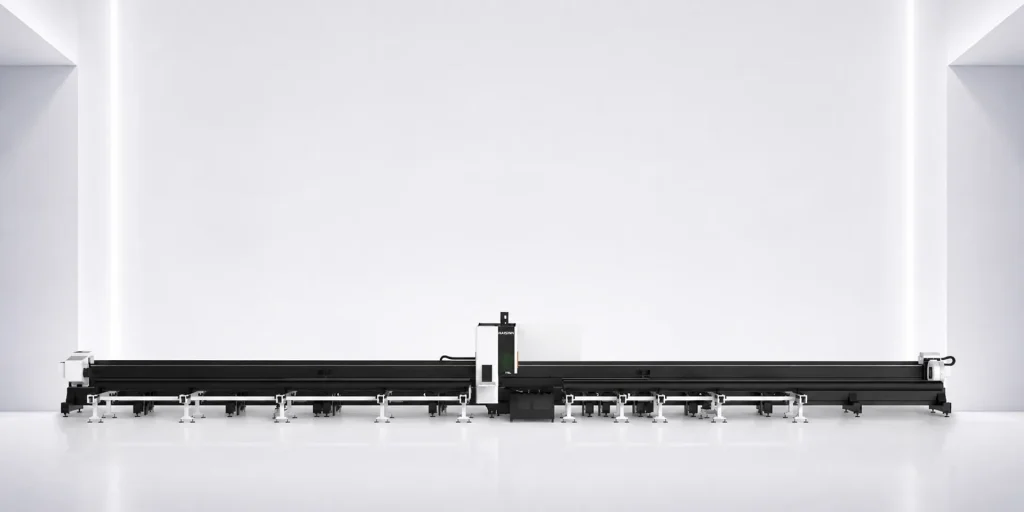
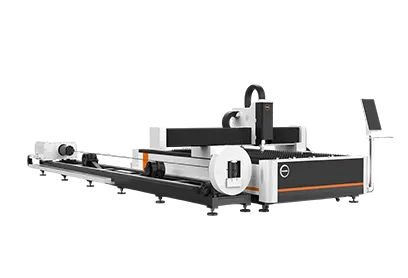
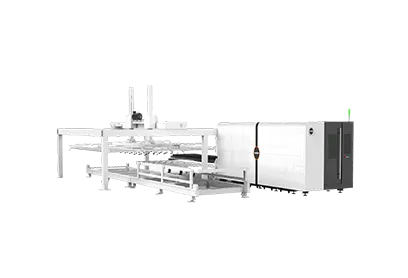
HS-TA product image from the HAISINN media library. Loading and receiving equipment must be confirmed for the ordered configuration.
Which HAISINN tube laser series should you compare?
The HAISINN tube laser cutting machine range includes configurations for different tube sizes, handling needs and production environments. Use the model-specific offer to establish capacity; do not combine the largest figures from several different models into one specification.
Heavy-duty tube cutting; model-specific clamping and power ranges
Confirm tube weight, support requirements and full rotating envelope
These descriptions are selection starting points, not a guarantee of output on your parts. The linked product pages are the configuration references; the final quotation and application trial should identify the ordered model and its limits.
If an enclosed machine is required, also evaluate the HS-T covered tube laser system. Confirm its enclosure, extraction, loading access and intended operating arrangement in the actual offer.
Why do tube length, weight and geometry affect price?
Raw-tube length and finished-part length are different
Specify both incoming stock length and the longest finished part. Include the space needed for loading and unloading. A machine capable of accepting a long raw tube still needs an agreed method to support and retrieve the finished component.
Check the floor plan with the loading device, receiving equipment, maintenance access and material staging in place. A bed-length figure alone is insufficient for planning the installation.
Weight matters as much as diameter
A large thin-wall tube and a smaller thick-wall tube can create different handling demands. Give the supplier the maximum weight per raw tube and the weight distribution of representative parts. Ask for the permissible load for the proposed configuration, not only the maximum published diameter.
Review support positions and the method for handling long or slender material. Incoming bow, twist and dimensional variation should be included in the sample review rather than assumed away.
Clamping and usable geometry
Confirm the jaw arrangement, contact surfaces, clamping sequence and any required change parts. Surface-sensitive tubes may need an agreed approach to contact marks. Irregular sections and parts with features close to clamping positions require a toolpath and collision review.
If bevels or special end geometry are required, identify them explicitly. A general tube-cutting specification does not automatically include a bevel head or a qualified bevel-cutting process.
Does more laser power always improve the investment?
Select power from the material and cutting requirements, then evaluate the full production cycle. Increasing available laser power does not eliminate time spent loading stock, locating parts, repositioning supports, unloading or changing jobs.
Ask for a complete cycle on representative production drawings. Record assist-gas conditions, consumable requirements and the finish obtained at the demonstrated settings. Compare the accepted output per shift, not a maximum axis speed or a straight-line demonstration.
Request electrical input and utility requirements separately from laser output power. Output kilowatts cannot be used directly as the complete installation’s electricity consumption.
When is automatic loading worth specifying?
Automatic loading is worth evaluating when recurring batches, compatible raw materials and a balanced downstream workflow allow the equipment to be used productively. Short batches and frequent profile changes require a separate assessment of setup and changeover work.
For the HS-TA or another automated proposal, ask which tubes the loader accepts, how mixed batches are managed and what personnel must still do. Identify stock replenishment, fault recovery, first-part inspection, finished-part sorting and scrap removal.
Workflow question
What a demonstration should include
Can the incoming stock be separated and presented reliably?
Actual profile, length and surface condition
What happens when a tube changes size?
Required adjustment, tooling and program change
Who retrieves and sorts cut parts?
Receiving method and handling responsibilities
Can later operations absorb the output?
Welding, bending, assembly and inspection capacity
How is an interrupted job recovered?
Defined procedure and operator involvement
Automation can move a bottleneck rather than remove it. Assess the complete flow from incoming bundle to accepted, sorted parts.
HS-M heavy-duty tube laser system. Confirm model-specific tube dimensions, weight and support limits in the quotation.
How should you compare tailing and material utilization?
Ask the supplier to define tail length and demonstrate it on the proposed chuck arrangement, raw tube and part program. A short residual segment on one test does not establish the usable material yield for every product.
Material utilization by length = length represented by accepted finished parts ÷ total raw-tube length consumed.
For the same section, this provides a useful length-based comparison. Account for cut kerf, nesting gaps, residual stock, rejects and unusable remnants. Where mixed sections or purchase-by-weight make length misleading, use a consistent mass-based or cost-based measure instead.
Illustrative utilization comparison
Suppose two trial plans each consume 600 m of identical raw tube. If one produces 540 m of accepted parts and the other 570 m, the recorded utilization is 90% and 95%, respectively. The accepted-output difference is 30 m for that trial quantity.
This is arithmetic using hypothetical inputs, not an HS-K, HS-TA or HS-M result. It does not establish a universal tail length, saving percentage or production rate. Replace the figures with the supplier’s nesting output and actual acceptance record for your drawings.
What belongs in the installed project budget?
An equipment comparison is useful only when inclusions are visible. Request the following scope from every supplier:
Budget item
Detail to establish
Cutting package
Source, power, cutting head, controls and cooling
Tube handling
Chucks, supports, loading and receiving equipment
Software
Drawing import, nesting, licenses, training and update terms
Utilities
Electrical work, gas supply, extraction and other specified services
Operating area
Required protective measures, access and installation layout
Delivery
Packing, freight, insurance, import charges and unloading
Commissioning
Location, responsibilities, duration and travel costs
Acceptance
Samples, measurements, trial scope and documentation
Service
Warranty scope, consumables, spare parts and support terms
Confirm the quotation currency, validity period, delivery term and named place. Keep site-specific construction and unresolved integration items visible rather than assuming they are inside the machine price.
How do you calculate the cost per accepted tube part?
Use total relevant production cost ÷ accepted parts produced for a defined period and part mix. Include tube material after a consistent treatment of recoverable scrap, labor, electricity, assist gas, consumables, maintenance and necessary rework.
For a full investment comparison, allocate depreciation and other fixed costs consistently. Compare the current process with the proposed process using the same drawings, quantities and acceptance rules. State whether any welding preparation, drilling or machining has been removed and verify that change on the actual part.
For mixed production, compare a representative basket of jobs. One highly favorable tube or contour cannot establish annual savings across the whole order book.
What should the acceptance trial prove?
Use traceable production drawings and representative incoming material. Agree which dimensions, hole features, cut faces and surface conditions will be inspected. Machine positioning specifications and finished-part accuracy are different measurements.
For automatic loading, include replenishment, loading, cutting, unloading and sorting in the agreed cycle. Check the first and later pieces in the batch, particularly where repeated clamping or long-part handling affects the result.
Record configuration, material, program, gas, settings, complete time, material consumed, accepted quantity and inspection results. Agree how the supplier will address a shortfall against the written acceptance criteria.
Prepare one brief for comparable quotations
Send the tube schedule, representative drawings, batch quantities, required output and acceptance criteria. Add raw-stock weights and lengths, loading preferences, available utilities, factory layout and delivery destination. Identify any future product range separately from current mandatory requirements.
How much does a HAISINN tube laser cutting machine cost?
The price is quoted for the selected configuration and delivery scope. Provide the tube envelope, material, weight, drawings, production target and loading requirements. This guide does not publish equipment prices.
Does a larger chuck mean every profile within that dimension will fit?
No. Confirm the profile’s full dimensions, rotation, jaw contact, support and cutting access. Use the model-specific capacity statement and a drawing review rather than a nominal chuck size alone.
Does automatic loading remove operator costs?
No. Establish the remaining responsibilities for replenishment, changeovers, inspection, sorting, fault recovery and maintenance. Staffing depends on the demonstrated production arrangement.
Can a standard tube laser produce bevels?
Only if the ordered head, motion configuration, software and process support the required bevel. Include the angle, root face and drawing requirements in the quotation and acceptance trial.
Is the shortest advertised tail always the lowest-cost option?
Not necessarily. Compare accepted material yield, cycle time and system cost on the same job basket. A tail-length claim does not describe the complete production result.
About HAISINN’s technical specialist
Warren Liu is HAISINN’s Chief Technical Specialist, with 17 years of experience in laser equipment and CNC equipment research and development. He has extensive experience customizing equipment to meet customer requirements. Send drawings and production needs through the HAISINN contact page for a configuration discussion.

















 November 23, 2026