Laser Welder Price: Handheld, 4-in-1 and Robotic System Costs
Blog
Practical Insights on Laser Technology, Equipment Selection, and Metal Fabrication.
Laser Welder Price: Handheld, 4-in-1 and Robotic System Costs
November 21, 2026
Technical contact: Warren Liu, Chief Technical Specialist at HAISINN.
Product specifications and references checked: November 21, 2026. The operating-cost calculation below is an illustrative USD example.
The cost of a laser welder depends on the laser source, power, cooling, welding head and equipment needed for the application. For Haisinn, the main systems to compare are AW air-cooled handheld welders, HCW four-in-one handheld welders and RW robotic welding solutions. Request a configuration-specific quotation to establish the purchase price and delivery scope.
For a purchasing decision, compare three figures: the equipment price, the installed project cost, and the operating cost per accepted part. A lower machine price may lose its advantage if it excludes essential workholding, site preparation, training or application testing.
This guide explains how to compare handheld, four-in-one and robotic laser welding systems, identify quotation exclusions, and prepare a useful request for a Haisinn configuration.
How much does a laser welder cost?
There is no single price that covers every laser welding application. A manual machine, a multifunction system and a programmed robotic workstation have different scopes. Even two machines with the same laser power may include different heads, cooling systems, accessories and support.
Use the following scope comparison to prepare a price request. HAISINN provides pricing through a configuration-specific quotation. Contact the team for a current offer covering your equipment and delivery requirements.
System being priced
Equipment scope to specify
Additional project costs to check
Handheld laser welder
Source, power, welding head, cooling and wire feeding
Workholding, operating area, utilities and training
Four-in-one handheld system
Welding package plus the required cleaning and cutting accessories
Mode changeover, task-specific consumables and shared machine capacity
Robotic laser welding system
Robot, source, welding head, controller and cooling
Fixtures, positioning, programming, protective measures and commissioning
Confirm the inclusions for each offer. Freight, taxes, installation and application-specific equipment can change the amount required to start production.
For a Haisinn comparison, specify the production task before asking for a price. Material, joint design, part size, production volume and acceptance criteria provide a more useful starting point than wattage alone.
Which type of laser welder should you budget for?
Choose the machine structure around how parts will be presented, held and welded. Power is one selection factor; the production workflow determines whether manual flexibility, multiple functions or programmed motion adds value.
Purchasing requirement
Haisinn system to evaluate
Published configuration
Main budget questions
Manual welding with movement between suitable workstations
AW air-cooled handheld system
0.8, 1.2, 1.5 or 2 kW options
Which power and cooling operating limits suit the actual workload?
Welding plus occasional cleaning and cutting tasks
HCW four-in-one handheld system
1.5, 2 or 3 kW; water cooled
Which functions, heads, accessories and changeover steps are included?
Repeated weld paths on parts that can be consistently located
RW robotic workstation
Published with a six-axis Yaskawa AR1440 robot and 2 kW MAX source
What fixtures, programming, positioning, guarding and acceptance work are included?
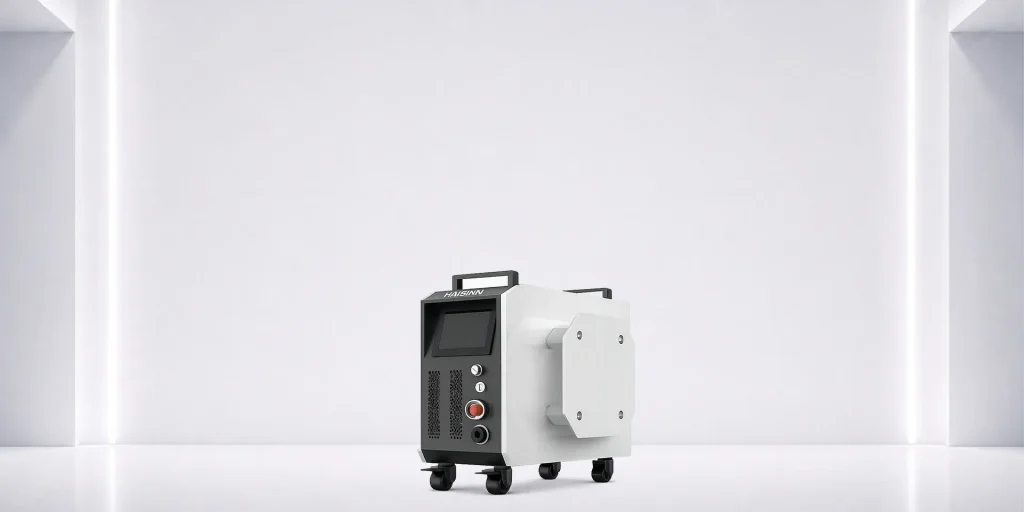
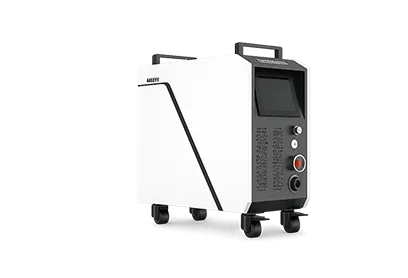
AW air-cooled handheld system. Confirm power and supplied accessories in the quotation.
When does a handheld laser welder make sense?
Evaluate a handheld system when the operator needs access to different seam positions or the workshop handles a varied mix of assemblies. Include part handling, clamping and operator availability in the comparison. A portable cabinet does not remove the need for a suitable controlled operating area.
For an air-cooled model, ask for the permitted ambient conditions and sustained operating limits at your proposed settings. Compare those requirements with your longest welds and shift pattern. Do not assume an air-cooled machine is always cheaper to run or that a water-cooled model is automatically necessary for every production task.
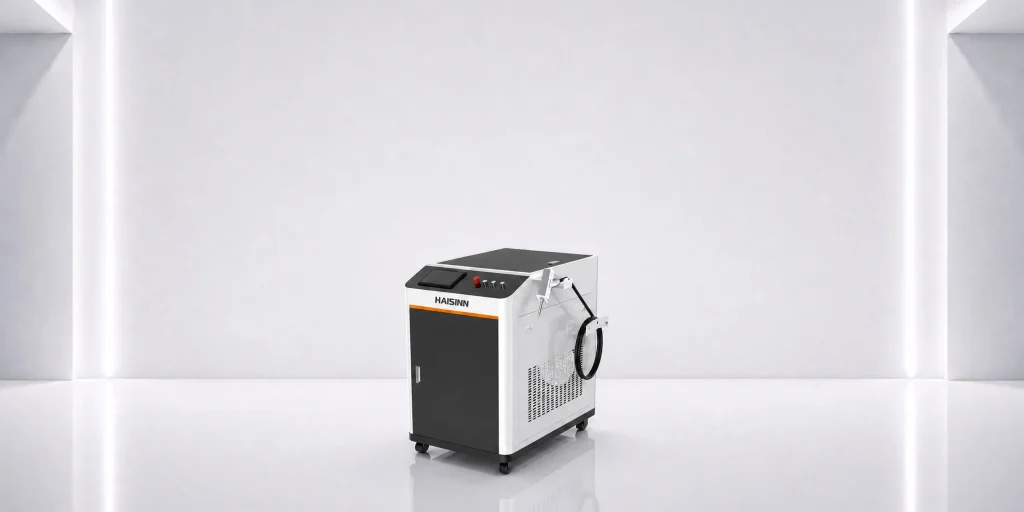
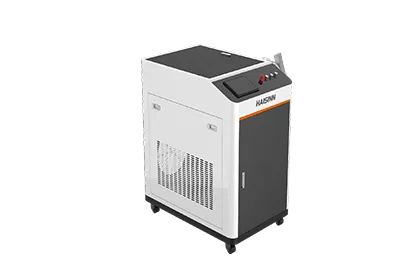
HCW multifunction system. Confirm accessories and changeover requirements for each task.
Is a four-in-one laser welder worth the price?
A four-in-one system is worth evaluating when the workshop will actually use its additional functions. Haisinn lists welding, cleaning, seam cleaning and cutting for HCW. Request a demonstration of each function that matters to your work.
Ask which accessories must be changed, how long changeover takes, and what output quality each mode can achieve on your material. A multifunction unit also shares available machine time between tasks. If cutting and welding must happen simultaneously, separate equipment may better suit the workflow.
Do not calculate savings by assuming a multifunction machine replaces every dedicated cutter or cleaner. Compare verified capacity and finish requirements for each task.
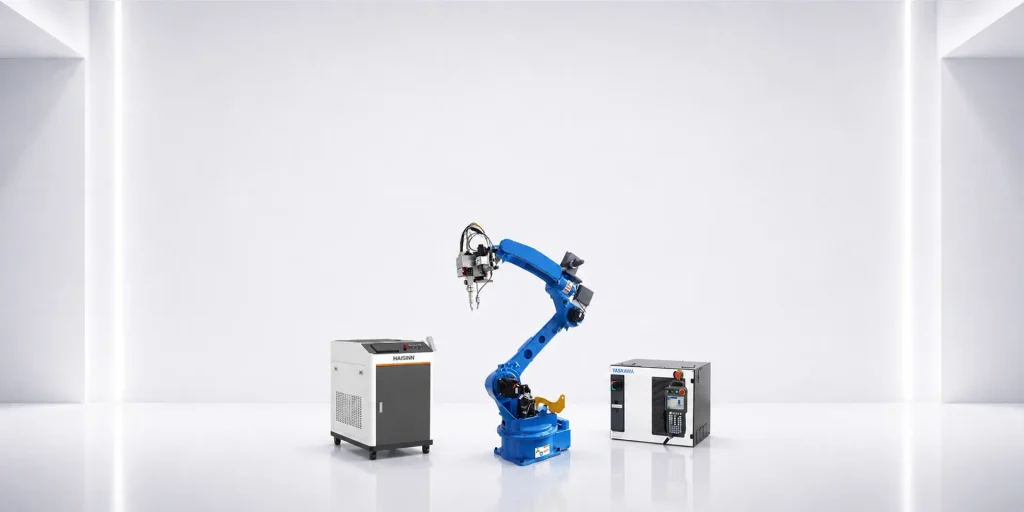
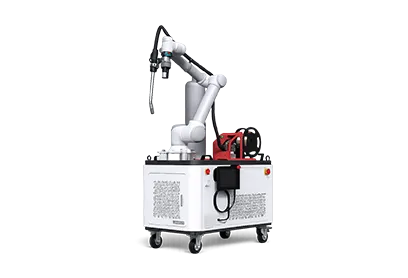
RW robotic welding solution. Fixtures and integration scope are specified for the application.
When should you evaluate robotic laser welding?
Evaluate a robot when parts can be held consistently and weld paths repeat often enough to justify programming and fixtures. A robot arm price alone does not describe a production-ready cell.
Request a project scope covering part location, loading, clamping, positioning, welding access, programming and inspection. Include fixture changes and product changeovers in the cycle-time calculation. A short welding demonstration is useful, but purchasing requires a repeatable process for the actual part mix.
What changes a laser welding machine price?
Laser source, power and welding head
Request the exact source model, rated output, head configuration and replacement-component availability. Compare the proposed setup against a representative joint, rather than assuming a higher power rating guarantees a better result.
Material grade, thickness, joint type, fit-up, filler wire and finish requirements should be defined before selecting power. Treat advertised maximum thickness as a starting point for questions, not proof that your part will meet its acceptance criteria.
Cooling, electrical supply and utilities
Check whether cooling equipment is included and whether the proposed electrical supply matches the site. Ask for input-power requirements separately from laser output power: the two are not interchangeable when estimating electricity costs.
Budget for any required electrical work, gas supply, extraction and other specified utilities. Compare the complete installation requirements of each proposed configuration.
Accessories, fixtures and automation
For a handheld system, verify the supplied wire feeder, gun, fiber length, nozzles and protective-window starter stock. For a robotic project, identify the fixtures, positioner, worktable, programs and interfaces included in the offer.
List custom tooling separately from standard equipment. This makes it easier to understand whether two quotations describe the same scope.
Delivery, commissioning and support
Have the quotation state its currency, validity period, delivery term and named place. Confirm who pays for freight, insurance, import charges, unloading and delivery to the operating position.
Then identify commissioning, training and support provisions. Ask what is remote, what is on site, which travel costs apply, and how spare parts and warranty claims are handled. Record written terms rather than relying on a general service statement.
What should be included in the installed project budget?
Installed project cost = quoted equipment + required accessories and fixtures + delivery and import costs + site preparation + commissioning and training. Add an explicit contingency for unresolved project items rather than hiding them inside the machine price.
Use this comparison sheet with every supplier:
Cost item
What to confirm before ordering
Machine and laser package
Exact models, power, cooling, head and supplied components
Wire feeding and consumables
Included feeder, supported wire, tips, nozzles and protective windows
Workholding
Standard table versus part-specific fixtures and clamps
Robot integration
Positioner, programs, interfaces and changeover scope
Operating-area preparation
Site-specific assessment, protective measures and extraction
Utilities
Electrical connection, gas and any specified air or cooling services
Logistics
Packing, delivery term, insurance, clearance and unloading responsibilities
Commissioning and training
Duration, location, attendees, travel and responsibilities
Acceptance
Samples, test method, quality criteria and documentation
Support
Warranty scope, exclusions, service arrangements and spare parts
Laser operating-area provisions belong in the purchasing budget. OSHA’s laser-hazard guidance discusses engineering controls, controlled areas, training, appropriate protective equipment and ventilation for relevant laser applications. Have the proposed installation assessed for its actual conditions and destination requirements; included eyewear alone does not establish a complete protective arrangement. OSHA Technical Manual: Laser Hazards
How do you calculate operating cost per accepted part?
Compare the cost of a finished, acceptable part, including handling and finishing. Welding travel speed alone leaves out loading, clamping, inspection, changeovers and rejected work.
Operating cost per accepted part = total production operating cost for the period ÷ accepted parts produced in that period.
For the same period, include labor, electricity, shielding gas, filler wire, consumables, routine maintenance, inspection and rework as applicable. Account for scrap without double-counting costs already included elsewhere. If you allocate equipment depreciation, keep the method consistent across alternatives.
Illustrative calculation—not a Haisinn performance claim
Assume a workshop records the following during one production hour:
Input
Illustrative value
Labor
$25.00
Electricity: measured 4 kWh at $0.15/kWh
$0.60
Gas, wire and consumables
$4.00
Maintenance allocation
$1.50
Total operating cost
$31.10
Accepted parts
40
Operating cost per accepted part
Approximately $0.78
The calculation is $31.10 ÷ 40 = $0.7775. Every input is hypothetical. This example excludes equipment depreciation, finance, facility overhead and taxes; include those when calculating full manufacturing cost. Replace the figures with measured consumption, local rates and verified output for your parts.
For an investment comparison, calculate annual net savings against the current process after accounting for expected utilization and additional costs. Use that figure with the installed project cost to assess payback. Do not treat an unverified welding-speed claim as a production-savings forecast.
What should you test before accepting a quotation?
Test a representative workpiece against agreed acceptance criteria before committing to a configuration. A convincing demonstration should explain the conditions that produced the result.
Provide material grade, thickness, joint drawings, fit-up expectations and finish requirements. Ask the supplier to record the machine configuration, power setting, wire, gas and welding conditions used for the sample. For a robotic project, include loading, clamping, positioning and unloading in the demonstration.
Define how quality will be assessed. Depending on the product, this may involve visual requirements, dimensional checks, leak testing or specified mechanical tests. A smooth-looking weld alone does not demonstrate every service requirement.
An acceptance record should connect the tested sample to its settings and inspection results. Agree which evidence forms part of the purchase specification and what happens if the agreed result is not achieved.
What information is needed for a Haisinn quotation?
Prepare one application brief containing:
Material grade and thickness range.
Joint drawing, weld length and accessible welding positions.
Part dimensions, weight, photographs and expected fit-up.
Finish and weld-quality acceptance requirements.
Daily quantity, shifts, batch sizes and product changeovers.
Current welding process and the problem the purchase should solve.
Available electrical supply, utilities and workshop conditions.
Destination, delivery scope, installation and training needs.
For robotic welding, add fixture concepts, loading arrangements and the expected part mix. For a four-in-one system, identify which cleaning or cutting tasks need to be demonstrated.
What is the difference between machine price and installed cost?
Machine price covers the scope listed in the equipment offer. Installed cost also includes the items required to deliver, prepare and commission that equipment at your site. Compare both using a written inclusion-and-exclusion list.
Is a 3 kW laser welder always a better purchase than a 1.5 kW machine?
No. Select power using the material, joint, quality requirements and production conditions. Have the proposed configuration tested on your part before paying for capacity that may not address the production constraint.
Can a four-in-one machine weld, clean and cut at the same time?
Do not assume simultaneous operation from a four-in-one label. Confirm the supplied configuration and mode-change procedure. For purchasing, budget shared machine time unless the supplier explicitly demonstrates and specifies concurrent operation.
Does a robotic laser welder eliminate operator costs?
No. Include loading, unloading, setup, programming, inspection and maintenance responsibilities. Assess staffing from the demonstrated cell workflow rather than the robot’s welding time alone.
How can I get a current Haisinn laser welder price?
Send Haisinn the material, thickness, joint drawing, output target and destination. Request a written quotation identifying the configuration, accessories and delivery scope. The operating-cost figures in this article are hypothetical calculation inputs and do not constitute a machine offer.
About HAISINN’s technical lead
Warren Liu is HAISINN’s Chief Technologist, with 17 years of experience in laser and CNC equipment research and development. His experience includes customizing equipment to meet customer requirements.
About HAISINN’s technical specialist
Warren Liu is HAISINN’s Chief Technical Specialist, with 17 years of experience in laser equipment and CNC equipment research and development. He has extensive experience in customizing equipment to meet customer requirements. For an application-specific discussion, send your material, joint drawing and production requirements through the HAISINN contact page.
















 November 21, 2026