Laser Rust Removal Machine Price: Equipment and Operating Costs
Blog
Practical Insights on Laser Technology, Equipment Selection, and Metal Fabrication.
Laser Rust Removal Machine Price: Equipment and Operating Costs
November 22, 2026
Technical contact: Warren Liu, Chief Technical Specialist at HAISINN. Product information checked: November 21, 2026. Equipment pricing is available by application-specific quotation.
A laser rust removal machine price depends on the laser configuration, cleaning head, workpiece condition and supporting equipment needed for the job. To compare offers, separate the machine purchase, installation budget and cost per accepted cleaned area. HAISINN provides configuration-specific quotations rather than public equipment prices.
Buying a cleaner and hiring a cleaning contractor are also different decisions. An equipment quotation purchases production capacity; a service quotation purchases an agreed result for a defined job. Compare them using the same substrate, contamination, access conditions and finish requirements.
What exactly are you pricing?
Purchasing option
What the quotation should describe
Costs to check separately
Cleaning machine
Source, power, cleaning head, cooling, controls and supplied accessories
Work area, extraction, utilities, delivery and training
Installed cleaning station
Equipment plus agreed installation and commissioning scope
Part handling, specialist site work and ongoing operation
Contract cleaning service
Substrate, condition, area, result and completion conditions
Mobilization, access, inspection, rework and waste responsibilities
Do not compare a contractor’s price per square metre directly with a machine purchase figure. Convert both into a cost for the same accepted work over a realistic production period.
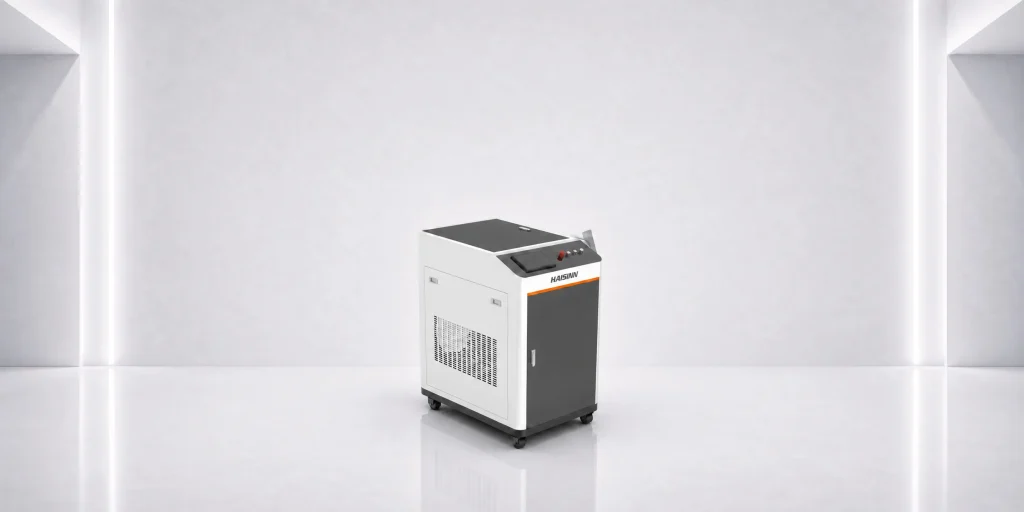
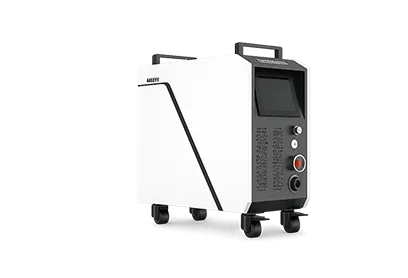
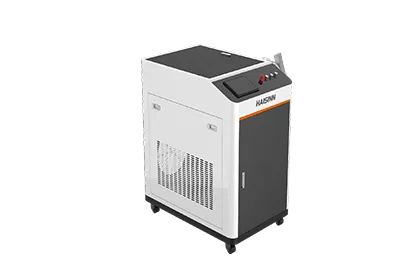
HC Series equipment from the HAISINN media library. The ordered configuration is confirmed in the quotation.
Which HAISINN cleaning configuration should you evaluate?
The HAISINN HC Series laser cleaning machine uses a mobile cabinet and handheld cleaning format. Its published parameter table lists 1.5–6 kW, a standard 10 m fiber with a maximum listed length of 15 m, and an adjustable cleaning range of 0–150 mm. Confirm the exact source, power, cooling and operating requirements in the proposed configuration.
Those figures describe equipment options. They do not establish an accepted cleaning rate, suitability for a particular coating or freedom from substrate change. Use a representative sample to establish those conditions before selecting equipment. The laser cleaning range overview is a starting point for discussing the application.
Confirm the laser operating mode
Ask whether the quoted source is continuous-wave or pulsed and request its relevant process specifications. Average power alone does not make two cleaning processes equivalent. For a pulsed proposal, pulse energy, pulse duration and repetition frequency are additional variables to discuss with the supplier.
This guide does not identify the HC Series as a pulsed cleaner. If the project requires a particular pulse specification, obtain written confirmation of an available configuration and a sample result. Do not infer that capability from a generic “fiber laser cleaner” description.
Match the equipment to the surface, not just the rust
Record the substrate material, thickness, component geometry and condition under the contamination. Thin sections, finished surfaces, sharp edges and dimensionally sensitive components need appropriate process assessment. Describe what must remain after cleaning as carefully as what must be removed.
For example, removing loose surface rust before fabrication and restoring a finished precision component have different acceptance requirements. Neither can be specified adequately by the phrase “remove rust from metal.”
What changes a laser cleaning machine quotation?
Contaminant and required result
Identify whether the job involves corrosion, paint, oxide, oil or several layers together. Include photographs and, where available, coating identification and thickness information. A photograph helps start the discussion but cannot establish the full composition or removal difficulty.
Then define the required endpoint: removal for inspection, preparation for coating, preparation for welding, or another documented condition. Ask how the supplier will demonstrate that endpoint. A visibly brighter surface is useful evidence of appearance, but it does not by itself prove cleanliness, roughness or downstream coating performance.
Access and part handling
Flat, accessible panels and intricate assemblies require different handling. Include corners, recesses, welds, rear surfaces and any restrictions on head access. Count repositioning, masking and inspection in the expected work time.
Discuss the fiber route and cabinet location in the actual workspace. Available fiber length does not establish a safe operating boundary or eliminate the need to protect nearby personnel and equipment.
Extraction and operating-area preparation
Budget for the controls required for the actual laser application and the contaminants being removed. Identify who assesses the area, specifies extraction and filtration, and handles collected material. The absence of abrasive media does not mean there are no fumes, particles or disposal tasks.
The OSHA laser-hazard technical guidance discusses beam controls and non-beam hazards, including airborne contaminants. Use competent site-specific assessment for the destination and workpiece; the equipment offer alone does not define the complete installation.
Delivery and service scope
Request the currency, validity period, delivery term and named place. Separate equipment, packing, freight, import costs, commissioning, training and any on-site travel. Confirm spare-part availability, consumable identification and written warranty coverage for the ordered configuration.
How should you calculate laser rust removal cost?
Operating cost per accepted square metre = production operating cost during the measured period ÷ area accepted during that period.
Use accepted area rather than the area scanned by the head. Count rejected sections and repeated passes consistently. Include preparation and handling in the same measurement period used for the operating costs.
Cost category
What to record
Labor
Setup, cleaning, part handling, inspection and necessary rework
Electricity
Metered consumption for the complete system, including supporting equipment
Consumables
Protective windows and other items specified for the configuration
Extraction
Filters, servicing and relevant collection or disposal costs
Maintenance
Planned service and a consistent maintenance allocation
Quality losses
Recleaning or rejected parts, without counting the same cost twice
For full ownership cost, add an explicit, consistent treatment of depreciation, financing, floor space and other overhead. Keep this separate from a narrowly defined operating-cost comparison.
A rate calculation to illustrate the method
Suppose a trial processes 12 square metres during a complete one-hour work cycle and 1 square metre needs recleaning before acceptance. If only 11 square metres are accepted during that hour, divide the hour’s recorded costs by 11, not 12.
These quantities are hypothetical and are not HC performance data. If recleaning is completed later, include its time and cost in the corresponding production record. Replace the example with a measured trial on your substrate and finish requirement.
Why scan width and head travel speed are insufficient
A wider pass can require overlap, several passes or different settings to achieve the same result. Advertised scan width multiplied by movement speed is not a validated production rate. The purchasing comparison needs the complete time required to produce an accepted area.
Ask for a trial record containing the contamination, substrate, settings, area, number of passes, complete elapsed time and acceptance method. Compare repeated samples where the incoming condition varies.
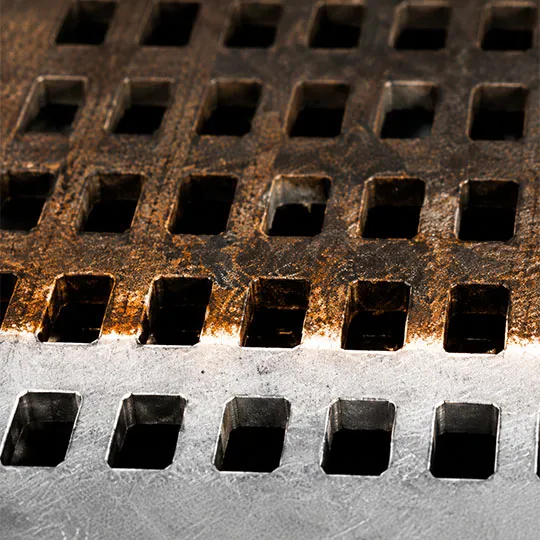
Surface comparison from the HAISINN media library. This illustrative image is not a documented cleaning-rate or acceptance test.
Should you buy a machine or outsource cleaning?
Evaluate ownership when recurring jobs, available personnel and suitable facilities can support enough productive use. Evaluate a service provider when demand is irregular, access is difficult or the project requires specialist resources you do not plan to maintain internally.
Decision question
Why it changes the comparison
How many accepted square metres or components are needed annually?
Determines realistic utilization
How variable is the contamination?
Changes production time and trial requirements
Is the workspace ready?
Determines site investment and commissioning effort
Can personnel be assigned and trained?
Affects scheduling and labor costs
What does the contractor include?
Prevents comparing unlike service and equipment scopes
Is cleaning the actual bottleneck?
Determines whether additional capacity creates useful value
A useful break-even estimate is annual fixed ownership cost ÷ (external service cost per accepted unit − internal variable cost per accepted unit). Use compatible units and comparable service scope. If the denominator is zero or negative, this calculation does not establish an ownership saving. Delivery schedules, quality control and capacity still require separate assessment.
What should be demonstrated before ordering?
Agree on the representative workpiece and acceptance method before the demonstration. Include the most difficult recurring condition, not only the easiest accessible surface.
Record substrate identification, contamination, incoming condition, machine configuration, process settings, complete work time and inspection results. Check whether cleaning changes dimensions, surface condition or downstream process performance where these matter to the product.
For coating preparation, agree with the coating specification owner which cleanliness and surface measurements are necessary. For sensitive components, define permissible material removal or surface change. Avoid treating a before-and-after photograph as a substitute for those measurements.
What should you send for a HAISINN quotation?
Provide:
Substrate material, thickness and component dimensions.
Rust, coating or contaminant information and clear photographs.
Total surface area, access restrictions and part-handling requirements.
Required final condition and inspection method.
Daily demand, shifts and expected variation between parts.
Available electrical supply, extraction arrangements and workshop conditions.
Destination, delivery scope, installation and training needs.
A representative sample, if available, for an agreed application trial.
How much does a HAISINN laser rust removal machine cost?
HAISINN provides a quotation based on the equipment configuration, cleaning task and delivery requirements. Send the substrate, contamination, area and finish criteria to obtain a comparable offer. Public numerical equipment prices are not provided in this guide.
Does higher laser power always reduce cleaning cost?
No. Evaluate the accepted output and operating requirements for the actual surface. Higher power is useful only if the proposed process meets the required result without unacceptable substrate change or additional production costs.
Does laser cleaning require no consumables?
Include the consumables and maintenance specified for the complete installation. Protective windows, extraction filters and collection or disposal requirements can remain relevant even when the process uses no abrasive media.
Can a laser cleaner remove rust without affecting the base material?
The result depends on the substrate, contamination, settings and acceptance limits. Verify it through an appropriate sample and inspection method rather than accepting a universal no-damage claim.
Is the cost per square metre enough to compare suppliers?
Only when the area, incoming condition, required result and included work are comparable. For complex assemblies, a cost per accepted component may describe the purchasing decision more accurately.
About HAISINN’s technical specialist
Warren Liu is HAISINN’s Chief Technical Specialist, with 17 years of experience in laser equipment and CNC equipment research and development. He has extensive experience customizing equipment to meet customer requirements. Send application details through the HAISINN contact page for a configuration discussion.
















 November 22, 2026