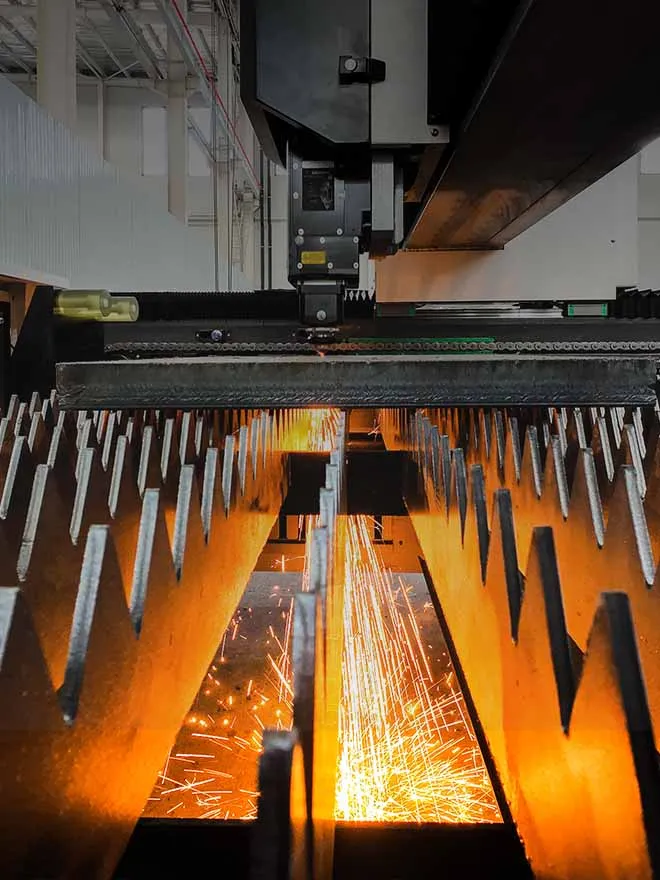
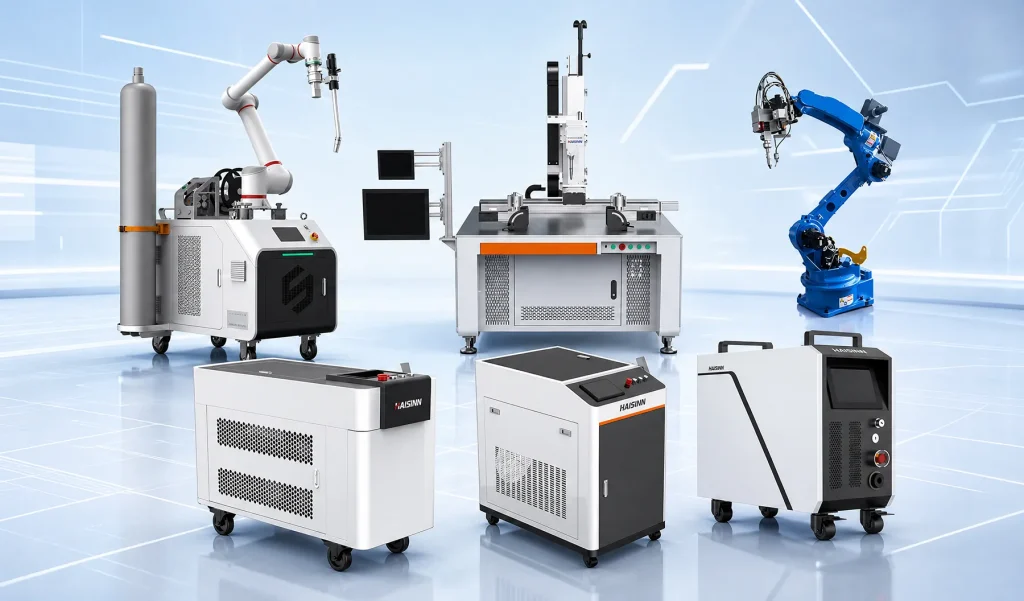
Handheld machines (SCW, AW) fit low-volume or repair welding where an operator moves the torch by hand. Workstations (DW) suit fixed, repeatable joints at moderate output. Robotic cells (RW) target high-repeat production where consistent, unattended cycles justify programming and fixture cost. The right pick depends on batch size, joint repeatability and available floor space.
What “Industrial” Actually Changes About the Decision
A fabrication shop weighing its first laser welder usually starts by comparing wattage. That’s the wrong first question once volume rises past a certain point. At low part counts, an 800W handheld torch and a 3,000W robotic cell can both finish the job — the difference shows up in how consistent the weld is from part 50 to part 500, and in how much labor sits next to the machine while it runs. Industrial buyers are really choosing a production system, not a laser source.
That distinction is why this comparison sorts by configuration rather than by power rating alone.
Four Configurations, Four Different Cost Structures
| Configuración |
Published Power Range |
Operator Role |
Typical Batch Fit |
Changeover Speed |
| Handheld (AW / SCW) |
AW: 800W, 1,200W, 1,500W, 2,000W; SCW: power range not fully disclosed, 10 m fiber cable |
Continuous hands-on welding |
One-off jobs, field repairs, and mixed small orders |
Minutes — the operator simply moves to the next part |
| Workstation (DW) |
1,500W, 2,000W, 3,000W |
Present at the station; guides or fixtures the joint |
Small-to-medium batches with a repeatable joint |
Fixture swap; faster than robot reprogramming |
| Multi-Function (HCW) |
1,500W, 2,000W, 3,000W |
Present at the station; switches between function modes |
Parts requiring welding plus in-line cleaning or cutting with one head |
Function-mode change rather than a complete machine change |
| Robotic (RW) |
Laser source: MAX 2,000W; robot: Yaskawa AR1440; intelligent swing head |
Programs and supervises; does not weld by hand |
High-repeat production runs |
Slower for a single new job; negligible once running |
None of these numbers are interchangeable across models — HAISINN configures the final robot, laser source and fixture package per project rather than shipping one fixed RW spec, so treat this table as a starting comparison, not a quotation.
DW Series — Fixed-Station Welding for Repeatable Joints
The DW Series is positioned as a fixed or workstation-based laser welding setup, published in three power options: 1,500W, 2,000W and 3,000W. It sits between handheld and robotic in both cost and control — the operator still positions and guides the weld, but the fixed station reduces the variability that comes from a handheld torch moving freely.
Where it pays off: shops running the same weld geometry every shift, but not at a volume that justifies robot programming and fixture engineering.
Where it doesn’t: if part geometry changes frequently, the operator ends up re-setting the station almost as often as they would reposition a handheld torch — at which point the fixed-station advantage narrows.

RW Series — Robotic Cells for High-Repeat Production
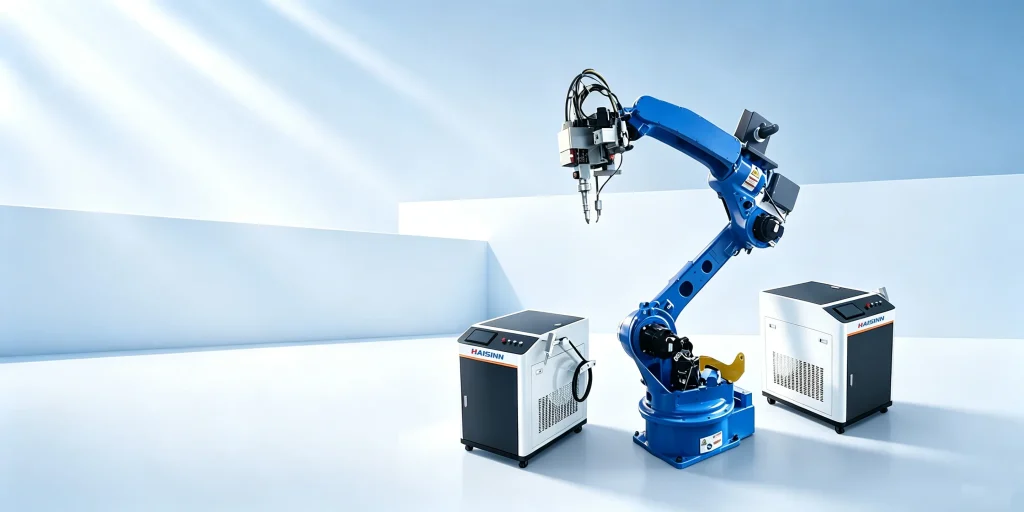
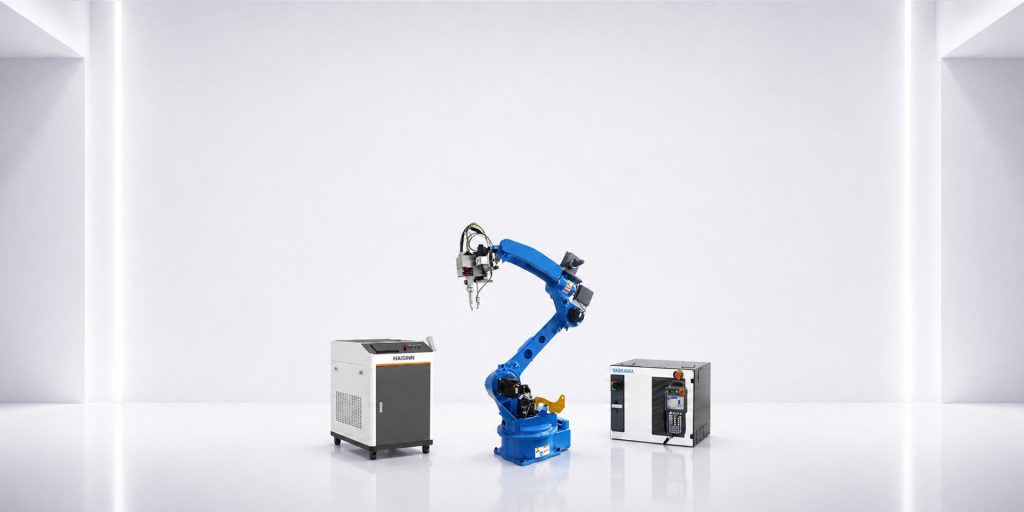
El Serie RW pairs a Yaskawa AR1440 robot with a MAX 2,000W laser source and an intelligent swing-head welding head. This is the configuration built for unattended, repeatable cycles rather than operator-guided welding.
The trade-off is upfront: programming the path, building the fixture and validating the cycle takes real engineering time before the first production part comes off the line. That cost amortizes well across thousands of identical joints. It amortizes poorly across fifty.
Where it pays off: structural frame production, repetitive assembly welds, multi-shift operations where labor cost per part matters more than upfront tooling cost.
Where it doesn’t: low-volume runs, prototype work, or product lines where the joint design changes often enough that reprogramming eats the automation savings.
HCW — When Welding, Cleaning and Cutting Share One Head
El Serie HCW is published in the same 1,500W / 2,000W / 3,000W power tiers as DW, but the function set is broader: laser welding, surface cleaning, weld-seam cleaning and laser cutting can be integrated into one machine, with the specific package depending on the ordered configuration.
That combination matters most when post-weld finishing is part of the real bottleneck — not the welding itself. A part that needs its seam cleaned or discolored oxide removed right after welding avoids a second station and a second material handling step. If cleaning and cutting aren’t part of your workflow, HCW’s added capability goes unused and DW covers the same welding task at a comparable power tier.

The Mistake Buyers Make Most Often
The recurring misconception isn’t about power — it’s the assumption that robotic is simply the “upgrade” from a workstation, and that more automation is always the safer long-term choice. It isn’t.
A robotic cell that sits idle between short, mixed-batch orders because each new part needs a new program and fixture check is not more productive than a DW workstation an operator can reposition in minutes. The right question isn’t “which machine is more advanced” — it’s “how many identical cycles will this run before the geometry changes again.” Below a certain repeat count, the fixture and programming overhead of a robotic cell outweighs its unattended-cycle advantage.
A Five-Step Way to Decide
- Count weekly weld cycles for the part in question — not total shop output, just that one joint or family of joints.
- Map whether the joint geometry repeats exactly or varies by product variant. Robotic and fixed workstations both assume repeatability; handheld tolerates variation.
- Check floor space and workflow: does the part travel to a fixed station, or does the welder need to move to the part?
- Compare the fully loaded cost of continuous operator time on a handheld or workstation setup against the one-time programming and fixture cost of a robotic cell, spread across your expected run length.
- Confirm the actual laser source, welding head and fixture package with a HAISINN sales engineer — RW and HCW configurations are finalized per application, not sold as one fixed spec.
Safety and Certification Considerations
Moving from handheld to a fixed workstation or robotic cell changes the safety envelope, not just the output. ISO 11553-2 sets safety requirements specifically for hand-held laser processing devices, which is a separate standard from the general laser processing machine requirements in ISO 11553-1 — worth checking against whichever configuration you’re evaluating. Laser classification and the associated warning labels and protective features for the equipment itself fall under IEC 60825-1.
On certification claims: Serie HCW‘s website makes company-level CE and FDA compliance claims, but the publicly reviewed pages do not display certificate numbers, issuing bodies or model-specific coverage. A specific DW, RW or HCW configuration should not be described as individually CE or FDA certified without checking the documentation for that exact machine build.
Preguntas frecuentes
How much does an industrial laser welding machine cost?
Pricing is configuration-dependent and not publicly listed. A formal quotation is prepared based on the required laser power, welding scope, automation level, core components, destination market and service requirements — so cost varies significantly between a handheld setup and a robotic cell.
Can I start with a DW workstation and move to RW robotic later?
Since the robot, laser source and fixture package for RW are selected per project, moving from a workstation to a robotic cell isn't a simple add-on — it typically means a new project scope and quotation rather than a direct upgrade path.
Does HCW replace the need for a separate cleaning or cutting machine?
HCW can integrate welding with surface cleaning, weld-seam cleaning and cutting, but the specific function package depends on the ordered configuration — confirm which functions are included before assuming full replacement of a separate machine.
Which configuration is easiest to staff?
Handheld and DW workstations both require an operator present through the weld cycle, so staffing needs are similar. Robotic cells shift labor toward programming and supervision rather than continuous hands-on welding.












 September 20, 2026