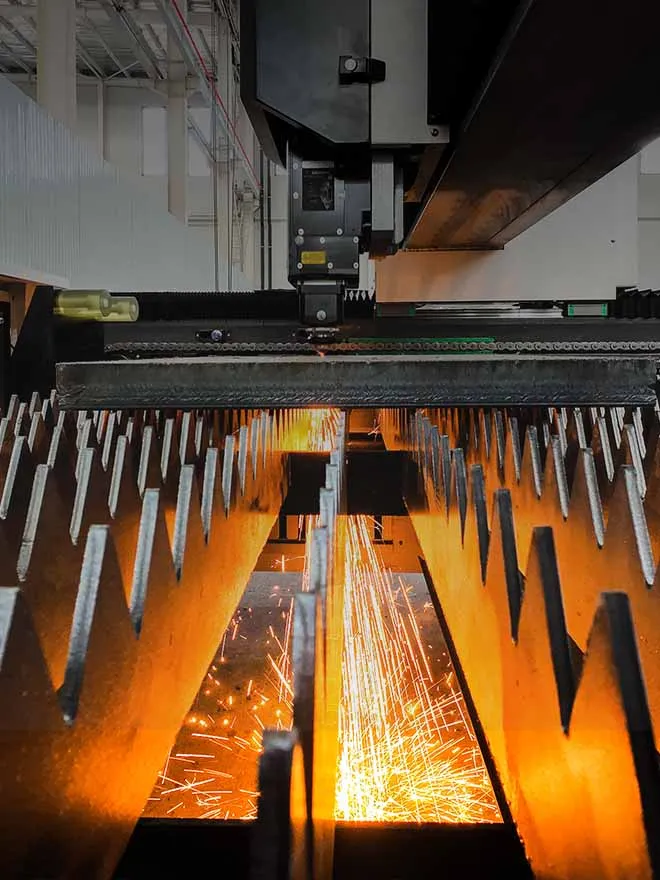
According to the 2026 China Laser Industry Development Report, domestic laser equipment market sales revenue reached RMB 95.8 billion in 2025, accounting for 58% of the global market, maintaining its position as the world’s largest market. The market size is expected to grow to RMB 102.5 billion in 2026, representing steady year-on-year growth of approximately 7%. The industry structure is undergoing significant changes: traditional flat-sheet cutting is facing increasingly intense competition, while high-value-added sectors such as laser welding, laser cleaning, and additive repair are experiencing rapid growth. The report predicts that the laser welding market is expected to surpass cutting within the next three years, becoming the largest segment in laser processing. Meanwhile, the localization rate of high-power lasers above 10kW has approached 80%, with continuous breakthroughs in the independent development and control of key domestic components.

According to insights shared at the OFweek 2026 Laser Industry Summit, the industry has officially moved beyond the first stage of simply competing through hardware upgrades and price reductions, entering an era of value competition centered on process optimization, software, and automation integration. “Laser + AI” has become the core driver of this round of industrial transformation. In the past, laser equipment heavily relied on experienced technicians to manually adjust processing parameters. Today, AI-based process systems can use visual and acoustic monitoring technologies to analyze cutting conditions in real time and automatically adapt to different materials and thicknesses. This significantly reduces trial cutting waste, lowers operator skill requirements, and is especially suitable for complex applications such as thick plate cutting, pipe bevel processing, and robotic welding.

Downstream demand is showing clear structural differentiation. General sheet metal processing orders remain stable, while high-value applications such as new energy storage cabinets, liquid cooling panels, construction machinery components, and shipbuilding steel structures continue to grow. Benefiting from environmental advantages, laser cleaning and laser cladding remanufacturing are gradually replacing traditional processes such as chemical pickling and sandblasting, creating new growth opportunities in heavy equipment repair markets. At the same time, demand for complete automated production line solutions is increasing. More end users are moving away from purchasing standalone machines and showing greater preference for integrated solutions combining loading and unloading systems with flexible sheet metal production lines.
In the second half of the year, two major industry exhibitions will attract significant attention: the MWCS CNC Machine Tool & Metalworking Show at the Shanghai Industry Fair in October and the DMP Greater Bay Area Industry Fair in December. Leading manufacturers are expected to showcase new products including 10kW+ self-developed laser heads, 3D five-axis processing technologies, and AI process control systems. These events will also provide important opportunities for connecting with global buyers and understanding future technology trends.
Overall, Chinese laser equipment manufacturers are transitioning from “single-machine exports” toward global expansion based on “complete solutions + localized services.” For equipment manufacturers and processing companies, focusing on specialized processing technologies, developing intelligent software capabilities, and building integrated production line solutions will be essential for navigating industry cycles and establishing long-term competitiveness. We will continue to track exhibition updates and advanced processing technologies while sharing the latest industry insights.
FAQ
What changes are happening in the laser metal processing industry?
The laser metal processing industry is moving away from pure hardware competition and price-based competition toward value competition focused on process technology, software, automation, and integrated solutions.
Why is AI becoming important in laser processing?
AI-based laser process systems can monitor cutting conditions through visual and acoustic technologies, automatically adjust parameters for different materials and thicknesses, reduce trial cutting waste, and improve processing efficiency.
What are the key growth areas in the laser industry?
High-value-added fields such as laser welding, laser cleaning, additive repair, and automated production lines are showing strong growth, while traditional flat-sheet cutting faces increasing competition.
How is AI improving laser cutting operations?
AI helps laser cutting systems analyze real-time processing conditions and optimize parameters automatically, reducing dependence on experienced operators and improving consistency in complex applications.
What role does laser cleaning technology play in manufacturing?
Laser cleaning provides an environmentally friendly alternative to traditional processes such as pickling and sandblasting, creating new opportunities in heavy equipment maintenance and repair applications.














 August 22, 2026