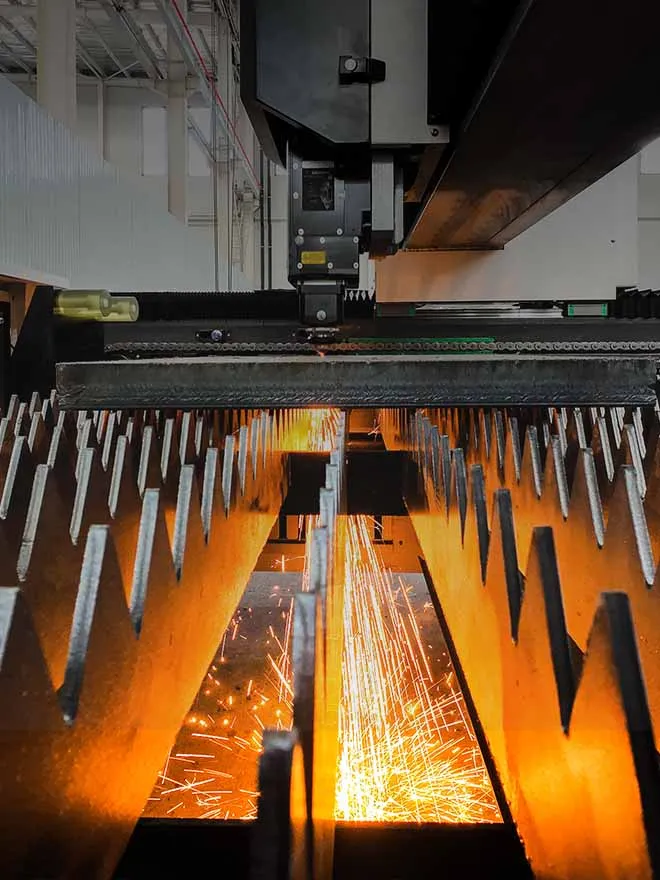
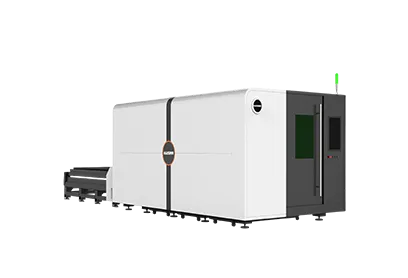
A CNC laser cutting machine is compared on five numbers: laser power, working area, maximum speed, acceleration and positioning accuracy. HAISINN’s HS-B exchange-table series publishes 1.5–30 kW, working areas from 3,048 × 1,524 mm to 6,050 × 2,500 mm, 140 m/min, 1.5G, and ±0.05 mm/m.
Those five figures fit on one line of a quotation. They are also where most spec-sheet comparisons quietly go wrong, because each number is measured under conditions the datasheet rarely prints.
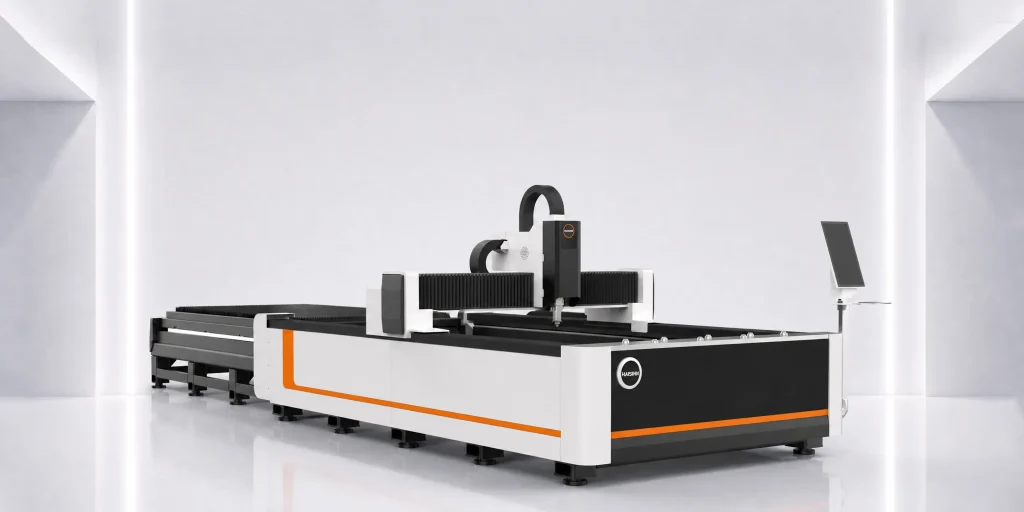
Published parameters: HS-B Exchange Table series
| Spec Dimension |
Published HS-B Figure |
What It Is Measured Against |
| Laser Power |
1.5–30 kW, model-dependent |
Source rating, not delivered power at the workpiece |
| Working Area |
3,048 × 1,524 mm to 6,050 × 2,500 mm |
Range across the series; per-model area to be confirmed |
| Maximum Speed |
140 m/min |
Unloaded axis traverse, not cutting feed rate |
| Maximum Acceleration |
1.5G |
Axis capability, not sustained across a full nest |
| Positioning Accuracy |
±0.05 mm/m |
Machine axis positioning, not finished cut-part tolerance |
| Table Structure |
Exchange (shuttle) table |
Two pallets, one in the cutting zone |
| Published Models |
HS-B3015, HS-B4020, HS-B6015, HS-B6025 |
Designation indicates nominal format; confirm exact area per model |
Two entries need a note rather than a number. HAISINN’s public series table gives the working-area range across the four models, not a per-model breakdown, so the nominal designations above should be read as format families and checked against the model table attached to your quotation. Laser power is likewise a series range: a 30 kW source is not available in every frame size.
What the exchange table actually buys you
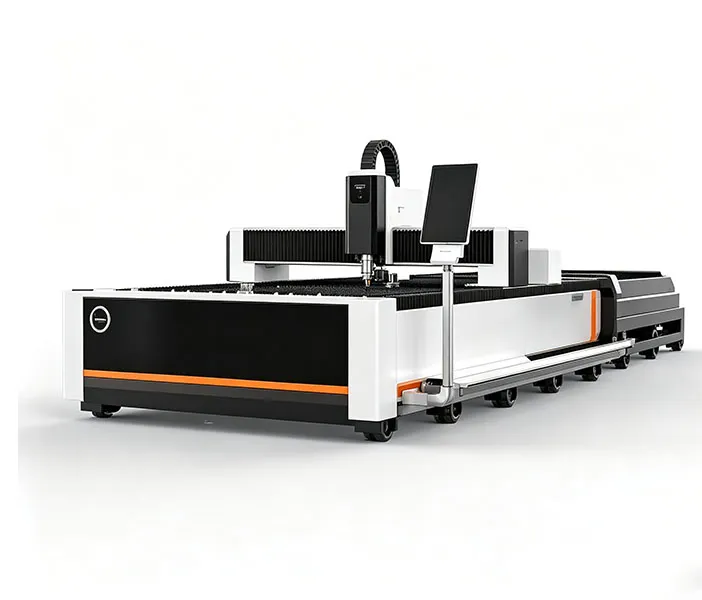
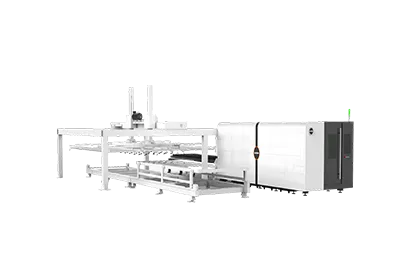
Compared with the single-platform configurations that are common in this equipment class, a shuttle table does not cut faster. Beam-on time per part is identical at the same power and material. What changes is the share of the shift the beam is on at all.
On a single platform, loading raw sheet and stripping cut parts happen while the head is idle. On an exchange table, that work happens on the pallet outside the enclosure while the machine cuts the sheet already inside. The gain scales with how much handling your parts need:
- Thin sheet, high part count, small nests. Handling time is a large fraction of cycle time. This is where the shuttle earns its cost.
- Thick plate, long beam-on cycles per sheet. A 20 mm carbon steel nest may run for many minutes; the handling you overlap is a small percentage of that.
- Mixed job shop work with frequent material changes. The second pallet becomes a staging area as much as a loading device.
- Single-part prototyping or very low volume. The overlap rarely triggers, and a single platform with the same power may be the better buy.
The uncomfortable version: if your operator currently spends four minutes handling and twenty-five minutes waiting for the cut, an exchange table changes very little about your output.
Positioning accuracy is not part tolerance
±0.05 mm/m describes how precisely the machine’s axes reach a commanded coordinate. It does not describe the dimensional tolerance or edge quality of the part that comes off the table.
Cut-edge quality belongs to a different framework. ISO 9013:2017 (with Amendment 1:2024), Thermal cutting — Classification of thermal cuts, defines the quality dimensions actually inspected on a cut edge: perpendicularity and angularity tolerance, mean height of the profile, and the resulting dimensional tolerance classes. A machine’s positioning specification is one input to that outcome. Nozzle condition, assist-gas pressure and purity, focus position, lens contamination, material surface condition and thermal state of the sheet are the others.
The practical consequence at purchasing stage: a positioning figure on a datasheet is not a commitment to an ISO 9013 quality class. If your parts are inspected to a specific class, that has to be established through a cut sample on your material and thickness, with the result written into the acceptance terms — not inferred from ±0.05 mm/m.
HAISINN’s Factory page describes a calibration target of up to ±0.03 mm for applicable equipment or processes, along with incoming, in-process and outgoing inspection stages and a stated 72-hour burn-in. These are company-published manufacturing process claims. Ask which of them applies to the specific model and configuration you are quoting, and what the acceptance standard is at each stage.
Speed, acceleration, and why 140 m/min is not a cutting speed
140 m/min is the rapid traverse figure — the speed the gantry moves between cuts. Cutting feed rate is a function of power, material, thickness, assist gas and required edge quality, and on thick plate it can be two orders of magnitude below the traverse number.
Acceleration is the figure that matters more on real nests, and it is the one buyers most often skip. On a nest of small holes and short contours, the head spends most of its time speeding up and slowing down; it never reaches maximum feed, let alone maximum traverse. 1.5G is the published HS-B ceiling. Whether it is sustained across a full-format 6 m table with a heavy gantry is a question for the acceptance test, not the brochure.
A workable request during evaluation: send your two most representative DXF files and ask for a cycle time estimate on the exact configuration being quoted, with the nesting software and assist-gas settings stated. A supplier who cannot produce that has not modelled your work.
Where this configuration is the wrong choice
Presented plainly, because the failure modes are specific:
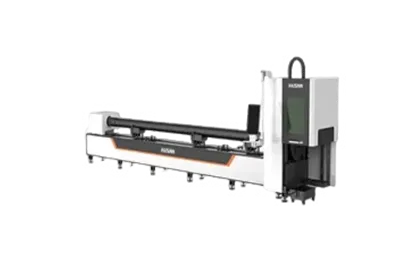
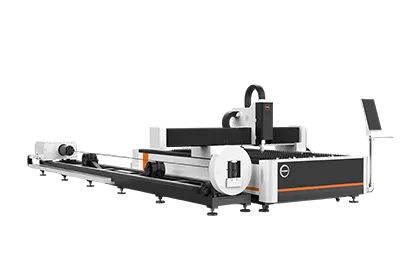
- Tube and profile work. An exchange table is built for flat sheet. Tube processing needs a dedicated chuck-based machine or a sheet-and-tube configuration; adding a rotary attachment to a sheet machine is a compromise on both.
- Floor space and foundation. Two pallets plus the exchange mechanism occupy meaningfully more floor area than the cutting envelope suggests, and the loading side needs clear crane or forklift access. On a 6,050 × 2,500 mm format this is the constraint that most often forces a layout change.
- Coil-fed production. If your input is coil rather than cut sheet, a shuttle table adds a de-stacking step that an automatic coil-fed line removes entirely.
- Maintenance surface. The exchange mechanism, its drive and its position sensors are additional wear items in a slag-and-dust environment. They are not maintenance-free, and no laser cutting machine is.
Certification and warranty: what to get in writing
HAISINN’s website makes company-level CE and FDA compliance claims. The reviewed public pages do not display certificate numbers, issuing bodies, declarations of conformity, FDA accession numbers, or model-specific coverage. That means no individual model — HS-B included — should be described as “CE certified” or “FDA certified” on the strength of the website alone.
For an EU installation, the relevant frameworks are Machinery Directive 2006/42/EC and Regulation (EU) 2023/1230, which replaces it from January 20, 2027. Machinery placed on the EU market near that date needs its applicable framework confirmed against the actual date of placing on the market. Laser-specific safety requirements sit under ISO 11553-1:2020 for laser processing machines and IEC 60825-1:2014 for laser product classification. For a US installation, 21 CFR 1040.10 and 1040.11 apply to the laser product, and manufacturer reports and accession information are the documents to review.
Documents to request by name before signing:
- EU Declaration of Conformity naming the exact model and serial configuration
- The CE certificate or test report with issuing body and number
- FDA accession number and the applicable manufacturer report, for US destinations
- Laser class and the safety interlock description for the enclosure supplied
Price
Pricing is configuration-dependent and is not publicly disclosed. A formal quotation is prepared according to the required laser power, working area, materials, automation level, core components, destination market and service scope.
FAQ
What laser power do I need?
Power follows material and thickness, and the HS-B series publishes 1.5–30 kW across models. Higher power increases thickness capability and speed on thick material, but a guaranteed cutting thickness cannot be stated without also stating the material, assist gas, cut requirement and accepted quality level.
Is an exchange table worth the extra cost over a single platform?
It depends on the ratio of handling time to beam-on time in your work. High part-count thin-sheet production overlaps a large share of handling; long thick-plate cycles overlap very little.
Can the HS-B cut tube as well as sheet?
The HS-B is a sheet configuration. Tube work is handled by dedicated tube machines or by sheet-and-tube configurations in a separate product line.
What warranty applies?
HAISINN's public statements vary between five years, two-to-three years on core components, and three years on the HS-B page. Confirm the term and component coverage in the model-specific quotation and contract.














 August 25, 2026