Pick the wattage tier by duty cycle and material thickness, then pick the cooling method by where the machine will actually stand. Air-cooled units in the 800–2,000 W range move between bays and need no chiller; water-cooled units suit continuous production at a fixed station. Cooling determines uptime more than wattage does.
The wattage number is the least reliable spec on the page
Most handheld laser welder listings lead with a single figure: 1,000 W, 1,500 W, 2,000 W. Buyers then compare that figure across brands as if it were a thickness rating.
It is not. The weld you actually get depends on the material and alloy, the joint geometry, fit-up gap, wobble amplitude, travel speed, shielding gas, wire feed if used, and the weld quality you have to deliver. Change any one of those and the same wattage produces a different result. A supplier who quotes “welds up to X mm” without stating all of the above is quoting a demo condition, not your production condition.
The practical version of the question is narrower: what is the thickest joint, in the specific material you run most, that this configuration can weld to your acceptance criteria, at a travel speed that makes the labour arithmetic work? Ask it that way and the conversation changes from marketing to engineering.
Wattage does govern two things reliably. Higher power increases available penetration depth on a given joint, and it increases the wobble width you can use while keeping enough energy density in the seam. That second effect matters more than most buyers expect, because wobble is how handheld welding tolerates the fit-up gaps that manual assembly produces.

AW Series: what is actually published
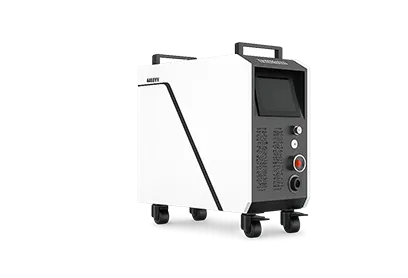
The AW Series Air-Cooled Handheld Laser Welding Machine is HAISINN’s air-cooled handheld line. Published power options are 800 W, 1,200 W, 1,500 W and 2,000 W, in an air-cooled handheld configuration.
That is the extent of what is published publicly, and it is worth being direct about it: fiber length, wobble width range, duty cycle at rated power, weight, input voltage and gas requirement are configuration items that belong in the quotation and the technical datasheet, not in a web page. Any of those figures you find quoted on a general listing site should be checked against the datasheet for the exact configuration being offered.
Compared with the general-purpose handheld packages that dominate this category, the specification questions worth pressing on are duty cycle at rated power in your ambient temperature, the wobble range the head actually supports, and what the warranty covers on the laser source as distinct from the rest of the machine.

SCW Series and the reach question
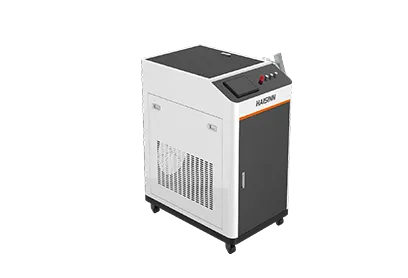
The SCW Series Handheld Laser Welding Machine is the water-cooled handheld configuration, with a published fiber length of 10 m.
Fiber length is an underrated spec. It sets how far the operator can walk from the cabinet, which decides whether large weldments can be welded in place or have to be moved to the machine. On structural or large fabricated assemblies, ten metres of reach can eliminate a crane movement per part, and that is a labour figure you can calculate before you buy.
HAISINN’s public category page does not provide a complete model-by-model power table for the SCW line. Request it in writing rather than inferring power from the air-cooled range.

If you are already buying robotic cells
For buyers specifying automated assembly, the handheld unit is usually the wrong tool for the parts that justified the robot, and the right tool for everything around them: fixture rework, prototype and first-article joints, short-run variants that never earn programming time, repair of parts that fail inspection, and welds in positions a fixture cannot present to the robot.
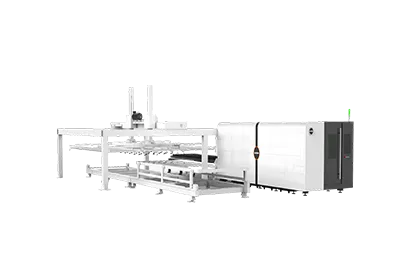
The comparison to run is not handheld versus robotic. It is which share of your annual weld metres is genuinely repeatable. Repeatable metres belong in a cell — HAISINN’s RW Series is published with a Yaskawa AR1440 robot, a MAX 2,000 W source and an intelligent swing-head configuration, with the final robot, source and fixture package confirmed per project. Everything that is not repeatable is where a handheld unit earns back its cost, and shops that buy only the cell usually end up buying a handheld welder within the year anyway.

Four things that catch first-time buyers
- Wobble does not eliminate fit-up requirements. It widens the tolerance band; it does not weld air. Assemblies that were cut and fitted for MIG will often need tighter preparation than the operator expects.
- Air-cooled does not mean cordless. These are mains-powered machines with a shielding gas supply. Portability means moving between bays, not welding on a rooftop without a power drop.
- Reflective alloys are a configuration question. Aluminum and copper behave differently from steel at the same wattage. Confirm the head, source and parameter set for the specific alloy, not the general material family.
- Galvanized and coated material produces zinc vapour. Extraction requirements are not the same as for uncoated steel, and this affects the installation, not just the operating procedure.
Safety and compliance: the part the buyer’s guides skip
A handheld laser welder is a Class 4 laser source with the beam delivery in a human hand. That combination is the reason this category has a specific standards framework:
- ISO 11553-2:2007 covers safety requirements for hand-held laser processing devices. Its current status and regional adoption should be confirmed for your destination market before purchase.
- IEC 60825-1:2014 covers laser product classification, accessible radiation, protective features and required manufacturer-supplied safety information.
- IEC TR 60825-14:2022 is the user’s guide for laser safety, covering workplace procedures, training, administrative controls and who holds laser-safety responsibility.
- ISO 12100:2010 provides the risk-assessment methodology, including foreseeable misuse, which for a handheld device is a substantial part of the risk picture.
On certification, be precise about what any supplier is telling you. HAISINN’s website makes company-level CE and FDA compliance statements. Certificate numbers, issuing or testing organizations, declarations of conformity, model-specific coverage and FDA accession numbers are not publicly displayed. No handheld model should be described as “CE certified” or “FDA certified” on the strength of a company-level website claim — ask for the document that applies to the exact configuration you are ordering, and note that “FDA certified” is not equivalent to a third-party product certificate in the way buyers usually assume.
Budget for eyewear at the correct optical density for 1,080 nm, operator training, and a defined laser-controlled area. These are not optional extras. They are part of the installed cost of the machine.
The manufacturing questions that separate suppliers
This category is full of units assembled from the same third-party sources and heads, sold under different names at similar prices. Component lists therefore tell you less than process control does. HAISINN’s Factory page describes incoming quality control, in-process quality control, outgoing quality control, component inspection, machine calibration, functional testing, processing validation and a stated 72-hour burn-in. These are company-published manufacturing claims; the useful move is to ask any supplier for the acceptance standard and inspection record that applies to your serial number.
Warranty deserves the same treatment. HAISINN’s own public pages are inconsistent on this point: the Warranty page refers to a five-year term, the Factory page describes two-to-three-year coverage for core components, and a product page states three years. The warranty period, the components covered, and the treatment of the laser source specifically must be confirmed in the model-specific quotation and the sales contract. That advice applies to every supplier in this category, and a supplier who will not put it in the contract has answered the question.
Pricing
Pricing is configuration-dependent. A formal quotation is prepared according to the required laser power, working area, materials, automation level, core components, destination market and service scope.
What can be said usefully is where the money goes after purchase: shielding gas consumption, consumable protective lenses and nozzles, coolant and filters on water-cooled units, eyewear and training, extraction for coated materials, and the electrical supply work if your shop is not already provisioned. Buyers who compare only the machine figure across suppliers are comparing the smaller half of the cost.
FAQ
What wattage do I need for stainless sheet?
State the thickness, joint type and required weld appearance and ask for a sample weld. Thin-gauge stainless is usually the easiest case in this category, and the risk at higher wattage is distortion from excess heat input rather than insufficient penetration.
Can one handheld laser welder replace our MIG and TIG setup entirely?
Rarely. It replaces a share of the work, typically thin-gauge and cosmetic joints where the reduced heat input and lower finishing time change the economics. Heavy structural joints, position welding in awkward access and coded weld procedures usually stay where they are.
How long does an operator take to become productive?
Basic competence comes quickly compared with TIG. Consistency across materials, gaps and joint types takes longer, and it is parameter management rather than hand skill that limits output once the first week is past.
: Do I need a separate chiller for the AW Series?
No. It is an air-cooled configuration, which is the reason to choose it. Confirm the duty cycle at rated power for your ambient conditions before assuming the trade is free.














 August 21, 2026