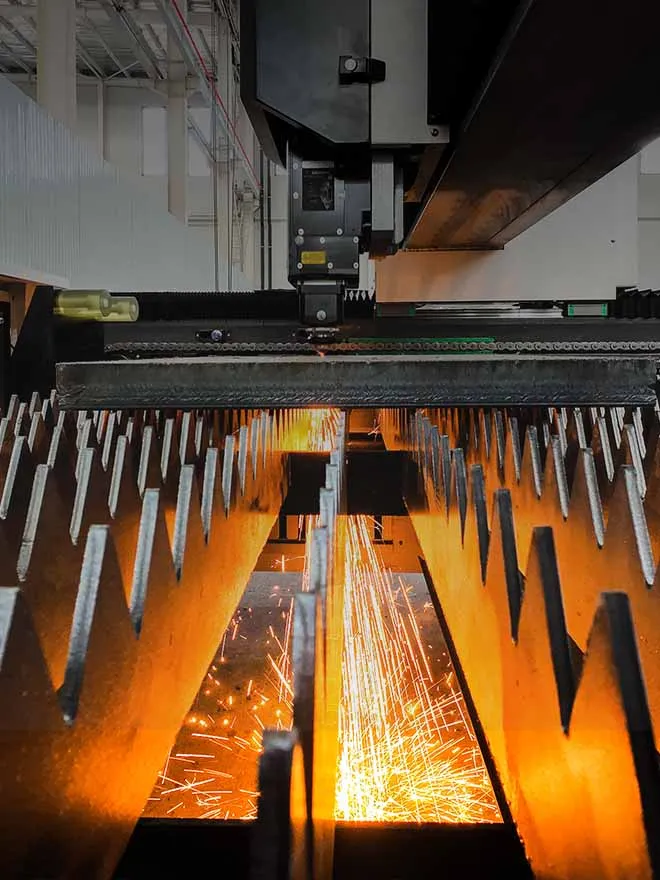
Choosing a sheet metal laser cutting machine comes down to four numbers: laser power matched to your material and thickness, working area sized to your parts, cutting speed for your production volume, and positioning accuracy for your tolerance requirements. HS-A and HS-B configurations cover 1.5–40 kW power and working areas from 3,048 × 1,524 mm to 12,200 × 2,500 mm.
Most buying guides for this category rank machines by brand name and stop there. Compared with that kind of brand-roundup approach, this guide works through the specific power, working-area, speed, and accuracy figures published for each configuration, plus the quality-control steps a machine goes through before it ships — information that rarely makes it into a listicle.
What Actually Determines the Right Laser Power?
Power selection gets treated as a single decision — “how thick is my material” — when it’s really two decisions stacked on top of each other. The first is whether the laser can cut the material at all. The second, more often ignored, is whether it can cut fast enough to hit your throughput target without burning through consumables or slowing the whole line down.
HS-A configurations are published with a laser power range of 1.5–40 kW, a maximum working area of 12,200 × 2,500 mm, top speed of 140 m/min, and maximum acceleration of 1.5G, with positioning accuracy of ±0.05 mm/m. That range spans job-shop entry points and heavy-plate production, so the practical question isn’t “does 40 kW exist” — it’s which point in that range matches your material mix today and your growth plan over the next few years.
A shop cutting mostly 3–10 mm carbon steel doesn’t need the top of that range. A shop moving into thicker plate, or one that wants headroom to add aluminum and stainless steel without re-quoting the machine in two years, does.
HS-A vs HS-B: Single-Platform or Exchange-Table?
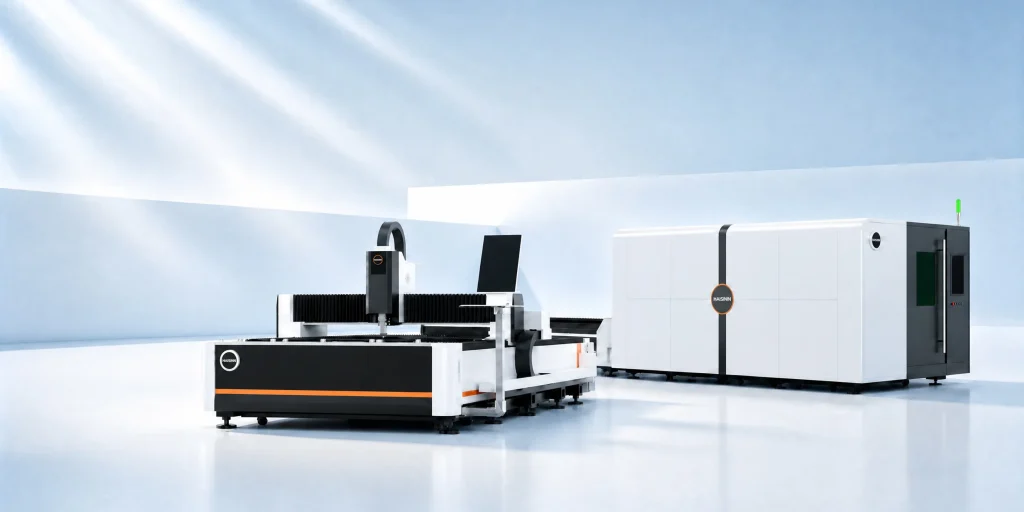
The power and speed numbers on HS-A and HS-B look nearly identical on paper. The difference that actually changes daily output is the table structure.
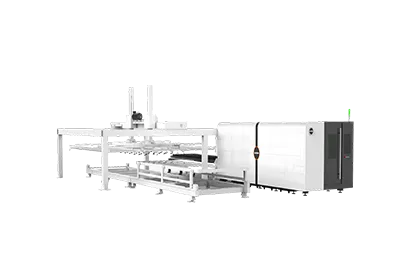
HS-A runs on a single fixed platform: load, cut, unload, repeat. HS-B uses an exchange-table setup, so one pallet is being loaded or unloaded while the other is under the beam. For a shop running long, unattended cut cycles on large sheets, that overlap is the entire reason to pay for the exchange-table configuration instead of the single-platform one.
HS-B is published across four models — HS-B3015, HS-B4020, HS-B6015, and HS-B6025 — with laser power from 1.5–30 kW and working areas from 3,048 × 1,524 mm up to 6,050 × 2,500 mm, at the same 140 m/min top speed, 1.5G acceleration, and ±0.05 mm/m accuracy as HS-A.
Reading the Spec Sheet — Working Area, Speed, and Accuracy
- Three numbers get compared side by side on most spec sheets, and they answer three different questions:
Working area answers “what’s the largest sheet I can load without nesting or splitting a part.”
- Speed (m/min) answers “how many parts per hour, assuming the geometry and material don’t limit it first.”
- Positioning accuracy (mm/m) answers “how repeatable is the machine’s motion,” which is not the same thing as cut-edge quality.
That last distinction trips up a lot of first-time buyers. Positioning accuracy describes how precisely the gantry moves to a coordinate. Cut-edge quality — squareness, kerf consistency, dross — is a separate outcome that depends on gas type, nozzle condition, focus, and material, on top of machine positioning. The international reference for classifying thermal-cut edge quality is ISO 9013:2017, and it should be the standard you ask a supplier to test against if a specific cut-quality class matters to your application, rather than assuming the positioning-accuracy figure covers it.
| Spec |
HS-A |
HS-B |
HS-C |
| Laser Power |
1.5–40 kW |
1.5–30 kW (model-dependent) |
Not clearly shown in the public table—confirm before quoting |
| Max Working Area |
12,200 × 2,500 mm |
3,048 × 1,524 mm–6,050 × 2,500 mm |
3,000 × 1,500 mm–12,200 × 2,500 mm |
| Max Speed |
140 m/min |
140 m/min |
Approximately 100–150 m/min, model-dependent |
| Max Acceleration |
1.5G |
1.5G |
Approximately 1.8–2G |
| Positioning Accuracy |
±0.05 mm/m |
±0.05 mm/m |
Approximately ±0.03–0.05 mm/m |
| Table Structure |
Single fixed platform |
Exchange table (dual pallet) |
Fully enclosed cabin |
Where an Enclosed Machine Like HS-C Makes Sense
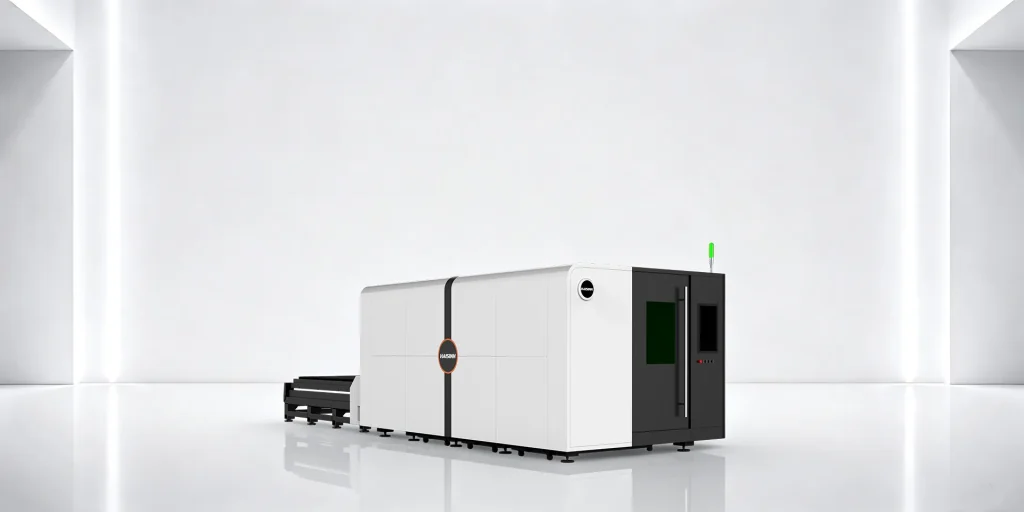
HS-C is published with six working-area configurations, from 3,000 × 1,500 mm up to 12,200 × 2,500 mm, faster acceleration (roughly 1.8–2G) and tighter published accuracy (roughly ±0.03–0.05 mm/m) than HS-A or HS-B. The trade-off is enclosure: a full cabin around the cutting area, typically chosen for beam-containment or shop-floor light and fume control rather than for a different cutting capability. The laser-power range for HS-C is not clearly shown in the public model table, so treat that spec as “to be confirmed with the supplier” rather than assuming it matches HS-A.
5 Sizing Mistakes That Show Up After Installation, Not Before
1.Sizing power to material type only, not to throughput. A machine that can technically cut your thickest material may still be undersized once you calculate parts-per-shift.
2.Choosing single-platform for a high-mix, high-volume shop. If sheets are loaded and unloaded constantly, the idle time on a fixed table (HS-A) adds up in a way an exchange table (HS-B) is built to avoid.
3.Sizing the working area to current sheets, not future ones. Nesting larger stock onto a bed that’s technically too small wastes material every single run.
4.Confusing positioning accuracy with cut-edge quality. They’re related but not interchangeable — ask for cut samples tested against ISO 9013 if edge quality is a hard requirement, not just the ±mm/m spec.
5.Ordering before confirming certification and voltage requirements for the destination market. CE and FDA documentation, along with electrical specifications, needs to be confirmed per model and per shipment before the machine leaves the factory, not after it arrives.
Behind the Spec Sheet: How the Machines Are Tested Before Shipping
HAISINN‘s factory page describes a quality-control sequence built around Incoming Quality Control (IQC), In-Process Quality Control (IPQC), and Outgoing Quality Control (OQC), alongside incoming component inspection, machine calibration, functional testing, and processing validation. The published process includes a 72-hour burn-in period and a calibration target of up to ±0.03 mm for applicable equipment.
These are company-published manufacturing claims that apply at the process level. They should not be read as a guarantee that every individual model or shipment follows an identical documented procedure — ask for the inspection report and acceptance standard tied to your specific order if that documentation matters for your internal qualification process.
CE and FDA Claims: What They Actually Cover
HAISINN‘s website makes company-level CE and FDA compliance claims. What the publicly reviewed pages do not show are certificate numbers, the issuing or testing organization, a Declaration of Conformity, model-specific coverage, or an FDA accession number.
In the United States, laser products fall under 21 CFR Parts 1000–1050, including 21 CFR 1010, 1040.10, and 1040.11 — the federal performance and reporting requirements for radiation-emitting products. “FDA certified” is not interchangeable with a generic third-party certificate under that framework, so if certification status affects your purchasing decision, request the manufacturer’s report, accession information, and labeling for the exact model and configuration before signing.
Service After the Sale
HAISINN describes an international service presence covering more than 80 countries and regions, including a Europe-based service presence with local engineers, spare-parts availability, a stated two-hour response mechanism, and 24/7 remote video diagnostics. Warranty terms published across HAISINN’s own pages are not fully consistent — the Warranty page states five years, the Factory page describes two-to-three-year coverage on core components, and the HS-B page states three years — so the applicable warranty period should be confirmed in the model-specific quotation and sales contract, not assumed from a single web page.
FAQ
What's the actual difference between HS-A and HS-B if the power and speed specs overlap?
Table structure. HS-A is a single fixed platform; HS-B uses an exchange table so loading and cutting happen in parallel, which matters most for shops running continuous, unattended cycles on larger sheets.
How much does an HS-A or HS-B machine cost?
Pricing is configuration-dependent and not publicly disclosed. A formal quotation is prepared based on laser power, working area, materials, automation level, core components, destination market, and service scope.
Are HS-A and HS-B machines CE and FDA certified?
HAISINN makes company-level CE and FDA compliance claims on its website. Certificate numbers, issuing bodies, and model-specific coverage are not publicly shown, so this should be confirmed with certificate and declaration documentation for the exact configuration before purchase.
What warranty comes with these machines?
HAISINN's published warranty information is not fully consistent across its own web pages (three to five years, depending on the page and component). Confirm the exact term in your quotation and sales contract.
How is cut-edge quality measured, separate from positioning accuracy?
Positioning accuracy (mm/m) measures how precisely the machine moves. Cut-edge quality — squareness, kerf, dross — is classified separately under ISO 9013:2017 and depends on gas, nozzle condition, and focus as well as machine motion.














 August 07, 2026