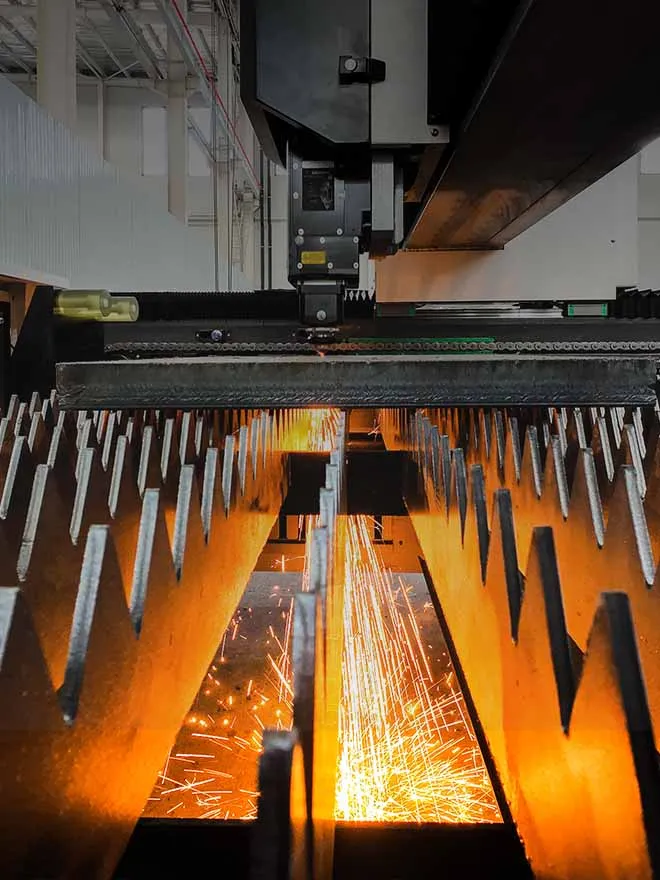
Thermal Deformation Hazards of Traditional Laser Equipment in Mass Production
During long-time continuous processing, heat accumulation brings multiple irreversible precision losses to standard laser machines:
1. Machine bed thermal bending deformation
After 8 hours of full-load cutting, the traditional non-stress-relieved welding bed will produce uneven thermal expansion. The linear thermal displacement of the beam guide base reaches 0.12mm, resulting in the horizontal offset of the laser cutting head, and the dimensional error of finished parts exceeds the ±0.1mm precision standard required by export workpieces.
2. Laser focal height drift
Heat radiation from laser generator and cutting nozzle transfers to Z-axis sliding table, causing vertical thermal expansion of sliding parts. The focal point drifts up and down by 0.08mm within one shift, which makes the slit width uneven, and thin plates are prone to burning edges and incomplete penetration.
3. Recurring dimensional inconsistency between batches
Temperature difference between the start and end of production shift changes the overall frame flatness. The size deviation of the same batch of profiles before and after production can reach 0.15mm, increasing the reject rate of finished products and the workload of rework inspection.
4. Accelerated aging of transmission components
Long-term alternating hot and cold environment aggravates the wear of linear guide rails and racks, shortens the service life of servo motors, and increases the frequency of equipment shutdown maintenance.

Core Modules of Thermal Deformation Suppression Technology
2.1 High-Temperature Stress Relief Annealing for Integral Machine Bed (Base Precision Guarantee)
The whole machine bed is welded with thick Q355 low-alloy structural steel, and adopts full furnace high-temperature stress relief annealing process at 580℃ after welding.
Eliminate more than 95% of welding internal stress inside the bed frame, avoid slow structural creep deformation under long-term alternating temperature difference;
After annealing, the overall flatness error of the bed is controlled within 0.03mm/m. Even after 72 hours of uninterrupted high-power cutting, the overall thermal bending displacement of the bed is controlled below 0.04mm, far lower than the 0.1mm deformation value of ordinary untreated beds.
The internal grid heat dissipation rib structure is added inside the bed, which accelerates natural air convection, balances the temperature difference between the front and rear of the frame, and avoids unilateral overheating and bending.
2.2 Multi-Layer Isolation Heat Barrier Structure to Block Heat Conduction Path
We set up independent heat isolation barriers for three major heat sources of laser equipment: laser generator, cutting head assembly and slag accumulation area.
High-density thermal insulation isolation plate is installed between the laser power cabinet and the beam gantry, which cuts off the radiant heat transferred from the laser source to the moving beam;
A heat insulation interlayer is arranged at the joint of the cutting nozzle and the Z-axis sliding table, to prevent the cutting residual heat from conducting upward to the precision sliding rail;
The bottom slag collecting bin is equipped with a separated air guide channel, which discharges high-temperature molten slag heat out of the frame, and avoids local overheating of the bed surface caused by long-term slag accumulation.
After multi-layer heat isolation, the temperature difference between the moving beam and the bed base is controlled within 3℃ during continuous processing, effectively inhibiting the thermal expansion difference of different metal materials.
2.3 Real-Time Multi-Point Temperature Closed-Loop Compensation System (Intelligent Dynamic Correction)
Distributed temperature sensors are embedded in the machine bed, X/Y/Z transmission gantry and laser beam guide parts, forming a full-machine temperature real-time monitoring network linked with the CNC system.
Collect temperature data of key components every 200ms, calculate the theoretical thermal expansion displacement of each structural part through the built-in material thermal expansion coefficient model;
The numerical control system automatically compensates the X, Y and Z axis travel coordinates in real time according to the thermal displacement value, offsetting the dimensional error caused by thermal expansion;
When the local temperature difference exceeds the set threshold, the system automatically increases the operating power of the cooling fan to adjust the heat dissipation efficiency.
Actual test data: After enabling the thermal closed-loop compensation function, the focal drift of the cutting head within 24 hours of continuous operation is controlled within 0.02mm, and the dimensional repeat positioning error of the workpiece is stabilized at ±0.03mm.
2.4 Integrated High-Efficiency Air Cooling Circulation Heat Dissipation System
A closed forced air circulation heat dissipation channel is laid inside the gantry and the bed, matching low-noise high-flow axial cooling fans:
- Form directional circulating air flow inside the frame, take away the heat generated by the guide rail friction and laser radiation in real time, and keep the operating temperature of transmission parts stable at 22-28℃;
- Independent air cooling channel for laser generator, avoid heat accumulation inside the power cabinet, stabilize the laser output power fluctuation within ±1%, and prevent power attenuation caused by overheating;
- The heat dissipation air duct is separated from the dust removal air duct to avoid dust blocking the heat dissipation channel and reducing the heat dissipation efficiency.
Measurable Production Benefits Brought by Thermal Deformation Suppression Technolog
Taking a factory equipped with 6000W fiber laser cutting machine for continuous 24-hour processing as the test object:
- Stable finished product yield
The dimensional qualification rate of workpieces processed for a long time is increased from 92.3% to 99.7%, and the rework and scrap loss caused by thermal deformation is greatly reduced.
- Reduce equipment maintenance frequency
Constant temperature operation environment slows down the aging speed of guide rails, servo and laser sources, and the annual replacement frequency of wearing parts is reduced by more than 60%.
- Adapt to uninterrupted batch production
It can stably support three-shift all-day production mode, without stopping the machine for 2-4 hours to cool down the frame as ordinary equipment, and the effective production time per month is increased by more than 120 hours.
- Meet high-standard export processing requirements
Long-term machining tolerance is stable within ±0.05mm, which meets the strict dimensional inspection standards of automotive parts, precision hardware and engineering machinery export orders.
Matching Application Scenarios of Full-Series Laser Equipment
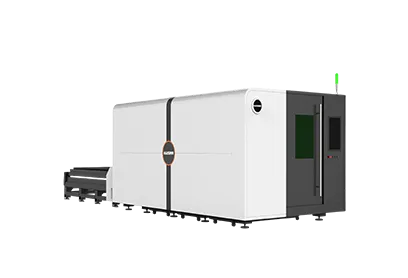
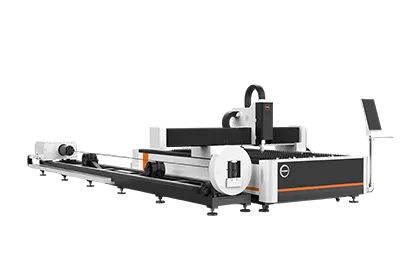
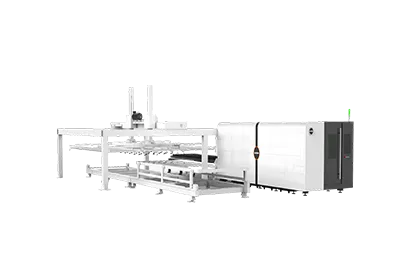
High-power flat laser cutting machine (3000W-20000W): Suitable for thick carbon steel, stainless steel mass cutting, solve frame thermal bending under long-time high heat load;
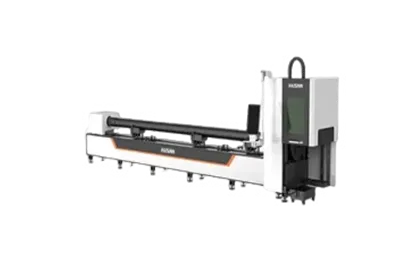
Long profile laser pipe cutting machine: For 6-12m pipe continuous feeding cutting, avoid thermal deformation leading to inconsistent hole positions and cutting lines of long pipes;
Precision small laser cutting equipment: Processing thin aluminum alloy, precision hardware parts, control focal drift to ensure uniform slit and smooth cutting surface;
Automated laser production line: Supporting fully automatic feeding and discharging unmanned workshop, realize stable precision without manual shutdown cooling.

Conclusion
Thermal deformation suppression technology is a systematic comprehensive technology integrating material heat treatment, thermal conduction isolation, real-time sensing and numerical control dynamic compensation, not a single simple heat dissipation upgrade.
It fundamentally solves the core industry pain point that traditional laser equipment’s precision gradually declines with the extension of continuous processing time. Through four core links of stress relief bed, multi-layer heat isolation, temperature closed-loop compensation and circulating air cooling, the equipment can maintain ultra-stable machining accuracy under long-term uninterrupted operation.
This technology is fully standardized and matched to all our full-series fiber laser flat cutting machines, laser pipe cutting machines and special-shaped profile laser processing equipment, providing long-term consistent precision processing guarantee for metal manufacturing enterprises of all sizes.
Web SEO Keywords
Laser equipment thermal deformation suppression, bed stress relief annealing, laser real-time temperature compensation, long-term precision laser cutting machine, laser gantry heat isolation technology, continuous processing thermal control solution.
FAQ
. What causes thermal deformation in a laser cutting machine?
Thermal deformation is mainly caused by accumulated laser residual heat, thermal radiation and friction heat during continuous processing. These heat sources can cause the machine bed, gantry, guide components and other structural parts to expand unevenly.
How does thermal deformation affect laser cutting accuracy?
Thermal deformation can cause machine-bed bending, laser focal-height drift and dimensional inconsistency between batches. It may also produce uneven kerf widths, cutting-head offsets and machining tolerances outside the required range.
How does stress relief annealing reduce machine-bed deformation?
The welded machine bed undergoes full-furnace stress relief annealing at 580°C. According to the article, this process eliminates more than 95% of the internal welding stress and helps prevent gradual structural deformation during long-term operation.
What is a multi-layer heat isolation system?
It uses independent heat barriers around major heat sources, including the laser power cabinet, cutting-head assembly and slag collection area. These barriers reduce heat transfer to the gantry, guide rails and machine bed.
What accuracy can the thermal compensation system maintain?
According to the test data presented in the article, cutting-head focal drift can be controlled within 0.02 mm during 24 hours of continuous operation, while workpiece repeat-positioning error remains at ±0.03 mm.












 July 27, 2026